Tag: bible

  • Even When I Don’t Know Why

    Even When I Don’t Know Why

    We’ve all been there. Facing a situation that leaves us scratching our heads, wondering why God allowed it to happen.

    Why did my loved one get sick? Why did I lose my job? Why did this relationship end? Why did this trial come my way?

    In those moments, it’s easy to feel lost, uncertain, and even questioning God’s goodness.

    Friend, I want to encourage you today that it’s okay to not know why. It’s okay to admit that we don’t have all the answers.

    What matters most is not understanding the why, but trusting in the Who.

    Trusting in a God who is sovereign, loving, and good. Trusting that He has a plan, even when we can’t see it. Trusting that He is working everything out for our good, even when it doesn’t feel like it.

    When We Don’t Know Why, We Can Still Know Who.

    In Psalm 23, David writes, “Even though I walk through the darkest valley, I will fear no evil, for you are with me; your rod and your staff comfort me.”

    David didn’t know what lay ahead, but he knew God was with him. And that’s exactly what we need to grasp in those moments of uncertainty.

    We don’t need to know why; we need to know Who is with us. We need to focus on the character of God, not the circumstances of our lives. We need to remember that He is our Rock, our Refuge, and our Savior.

    “Faith is not about having all the answers; it’s about trusting the One who does. There will be times in life when we don’t understand why things are happening the way they are. We may face challenges, struggles, or uncertainties that leave us questioning God’s plan. Or, even God Himself.

    Even when we don’t know why, we can know Who is with us. We can trust in His goodness, His love, and His sovereignty. We can rest assured. He is working all things together for our good. This is true even when we can’t see the bigger picture.

    In those moments of uncertainty, let’s lean into faith. Let’s choose to trust, even when we don’t understand. Let’s remember that God’s ways are higher than ours, and His thoughts are beyond our own. Let’s fix our eyes on Him, rather than our circumstances.

    We may not understand the reasons, but we can still know that God is good. We can be certain that He is faithful. He is always with us. We can still choose to praise, to pray, and to trust.

    In the midst of uncertainty, we will find that our faith grows stronger. Our hope is renewed. Our heart is more deeply rooted in the love of Christ.

    We all want life to be fair. We want goodness to prevail and hard work to mean that life will be easier and … that green grass on the other side of the fence that belongs to the people who don’t appreciate it? We’d like that to be transplanted on our lawn because we are spending all day feeding and watering the sparse looking grass on our side of the fence.

    But all of that is “me” thinking… and it’s not about me.

    The plain and simple truth is that we are tiny blips on a very big screen. This is clear if we take big lessons in life and strip them down to the bare essentials. Only God has the capacity to see all of it.

    He saw all that came before us. He sees all that will come after us. Only He can know the role that each of us can play that will best serve Him and each other.

    Life may not be ideal by our standards. But, it’s not about me. It’s about what He can do with my life.

    Through trials in my life, I have learned a lot about myself. I have learned a lot about my faith. I have also gained perspective from the difficulties I have faced. But that doesn’t mean I was given each of those difficulties to teach me something.

    God knew what I would go through in life. He helped nurture me. I want to use my experiences to positively impact others.

    I would like to be exempt from hardship. However, if it serves a purpose for another person, I accept it. It may help them see their life or relationship with God in a new light. Because of that, I wouldn’t ask for it to be taken from me.

    Because it’s not about me. Nothing about my life is about me… it’s about who He needs me to be.

    And how can I complain about that?

    Oh, complaining can come so easily for all of us. Your small house. Your flat tire. The promotion that should have been yours. The grass grows so fast you don’t have the time to mow it…

    But, what if God blessed you with that small house so you are next to a neighbor who needs your help when her husband dies? Or, your tire went flat so it didn’t happen when your teenage son was driving? Maybe the promotion would have been a dead end for you and next year a better opportunity will be waiting. And that lawn? Maybe it’s the only exercise you do each week and is saving you from a heart attack.

    The point is, you don’t know. I don’t know. But it’s not about me.

    So, as far as I’m concerned, even those things that make me want to pull my hair out and scream “Why me?!?” are blessings in disguise.

    Blessings for me, or for someone else, or for a reason I can’t even imagine.

    But it doesn’t really matter. Because it’s not about me.

    So, I’m sticking with trusting the Who, instead of seeking the why.

    With love and joy,

    Laura
  • Silent Prayer

    Silent Prayer

    When I first began my career in coaching and training, I found it very hard to just sit in silence.

    The silence of waiting for someone to give a thought was palpable. It also arose when waiting for an answer to a question. Or even when asking for a volunteer. I had a need to fill the silence.

    Do you ever feel that way when you pray?

    My prayer often looks something like this…I pray for what I want. I thank. I want. I thank. I talk. I listen. And then I talk some more. I find myself so drawn to stay in conversation with Him.

    I get tired of repeating what I know He already heard. I also get tired of mentioning what I know He has already taken care of. I just don’t know the outcome yet.

    As a natural introvert, I get anxious going to events where I don’t know people. I stress over what to talk with people about. How to start a conversation without relying on weather talk. How to avoid offending them by asking what they may find to be a personal question.

    How to keep a conversation going in- order- to avoid that awkward silence and stand there with nothing to say.

    Can you relate? I am in awe of individuals who can immediately feel comfortable at those events and know just what to say.

    Communication is a two way street. It’s not all up to me to keep the conversation going. It is a joint effort and a combination of both talking and listening. Listening for those clues in the conversation that will spark other topics of conversation.

    I think prayer needs to be the same way. Not just one sided talking about what I want, need, and desire. It’s also about listening.

    Just being quiet in the silence to hear what is being said. We need to just Be.

    When I sit in the quiet and silence my mind. I realize I am being drawn not to keep talking to Him. Instead, I am drawn to “be” with Him. To just rest in His presence and know I am okay.

    He asks us to “be still and know that He is God.” We don’t have to work to fill the silence.

    I have been in a time of In-between lately. A time of no longer and not yet. This in between place is also a place that can feel very silent. A time of feeling very alone. A time when I am drawn to fill the silence with anything but that…silence.

    What God has had me doing doesn’t seem to be working. However, I am not yet in the fullness of God’s promise. It’s easy to feel stuck, uncertain, and restless. I have found in scripture that this in-between season is not without purpose.

    In 2 Corinthians 5:5, we’re told that we are “God’s workmanship, created in Christ Jesus to do good works, which God prepared in advance for us to do.”

    Even in the waiting, God is working in us and through us.

    I have found that the best things to do when in a season of in-between, is to:

    1. Pursue intimacy with God: I have used this season to deepen my relationship with the Lord. Spending time in prayer, reading Scripture, and worship. As I have drawn near to Him, I’ve found comfort, guidance, and strength for the journey ahead.
    2. Reflect and learn: It has been a time to reflect on the season I may have to leave behind. What has God taught me? What can I carry forward into the new chapter? What are areas for growth? What do I need to surrender to God?
    3. Prepare for what’s next: I might not know exactly what God has in store. However, I can prepare my heart and mind. I can develop habits, skills, and character that will serve me well in the future.
    4. Serve others: I have looked for ways to serve and bless those around me. It has been a powerful way to shift my focus from my own waiting to being a blessing to others.
    5. Trust in God’s sovereignty: I am remembering that God is working all things together for my good (Romans 8:28). I trust that He has a plan, even when I can’t see the outcome.

    If you are navigating the in-between, hold fast to the promise of Jeremiah 29:11.

    “For I know the plans I have for you,” declares the Lord, “plans to prosper you and not to harm you, plans to give you hope and a future.”

    My friend, I pray that you find peace, purpose, and joy in the in-between. Know that God is with you every step of the way.

    Trust Him enough to simply rest in His presence. To simply be…

    In the silence.

    With love and joy,

    Laura

  • The Freedom of Forgiveness

    The Freedom of Forgiveness

    I learned a new word this week!

    Unrequited:

    1. not returned or reciprocated: unrequited love.
    2.not avenged or retaliated: an unrequited wrong.
    3.not repaid or satisfied.

    I’ve been thinking about forgiveness this Lenten season.

    Forgiveness is a concept that can be both beautiful and brutal, depending on the context. On one hand, forgiveness offers a chance for healing, restoration, and new beginnings. On the other hand, it can be a painful and difficult process, especially when faced with hurtful or traumatic experiences.

    As Christians, we’re called to forgive others just as God forgives us. But what does that really mean? How do we do it?

    In the Bible, forgiveness is a recurring theme that showcases God’s merciful nature. From the Psalms to the Gospels, we’re reminded that forgiveness is a fundamental aspect of God’s character.

    In Matthew 6:14-15, Jesus teaches us that our forgiveness from God is directly tied to our willingness to forgive others. This doesn’t mean that God’s forgiveness is conditional. Instead, our experience of His forgiveness is deepened when we extend forgiveness to others.

    For many of us, forgiveness is a struggle. Forgiving is letting go of and accepting what has been. When we forgive, does it mean that we are saying what was done to us is okay? Does it mean that we are saying they are right and we are wrong?

    I don’t think so.

    One of the hardest things about forgiveness is that it often feels unrequited. Whatever was done that requires forgiveness often leaves us broken or empty, and sometimes those feelings weren’t validated. And perhaps still aren’t.

    As much as our deepest desire is to sometimes retaliate for being hurt, that’s not what forgiveness is all about. Even when matters are resolved to the best of everyone’s abilities, the injured party may still feel unsatisfied. Unrequited.

    Being wronged hurts. Speaking forgiveness is sometimes easy. However, truly feeling it is often hard.

    It’s a feeling of deciding whether we’d rather be right or if we’d rather be happy. If we’d rather hold onto our righteous hurt, or if we’d rather extend grace. Let’s be honest, we’re human, it’s our impulse most of the time to hold on rather than leave ourselves unrequited.

    I was given a whole new clarity about forgiveness when I came across this phrase:

    Forgiveness is giving up the possibility of a better past.

    It makes sense, doesn’t it? We hold onto things because they are unrequited. Because they hurt us. Because they never should have happened in the first place. Because we want to go back to the time before we were hurt and make it not happen. We want a better past.

    But that’s not possible.

    Life happened.

    The possibility for a better past just doesn’t exist. But the possibility for a better future is available to each and every person who is still breathing.

    We can let go of the hurt and the anger. We can release the need to once again say, “But I was right!” Each of us can decide that our future will be better. We have the opportunity to make our future better than our past. And we have the opportunity to give someone else the grace to know that, too, by extending forgiveness.

    By doing as Christ has done for each of us over and over and over again.

    Imagine if He looked as us and said, “But I was right,” instead of, “But you are Mine.”

    Letting go of the possibility of a better past means that a better future is possible. However, it doesn’t always mean both people will choose that path. There are people in my life who I have forgiven, knowing the past cannot change. But some of those people choose to live out the same actions over and over. They have the possibility for a better future, but they are choosing not to take it.

    I can forgive them without walking back into unhealthy situations. I can forgive them, and still choose not to play the game. I hope someday they will choose a better future, and I will cheer them on if they do. In the meantime, I care about them from a distance. I think, just like God does with us, we can stay where we are when they move away. And still be here when they choose to come back.

    Saying I’ll forgive and forget isn’t practical, because I don’t think we can forget. I think forgiveness happens in us. It occurs when we do remember what had been done to us without feeling like we did when it happened. It becomes just a memory. It’s a past that can’t be changed for the better, followed by a future that can.

    I’ve learned that leaving things unrequited can be a beautiful gift. It means they can be left where they belong so forgiveness can be given, received and cherished.

    With love and joy,

    Laura

  • All about the Comma

    All about the Comma

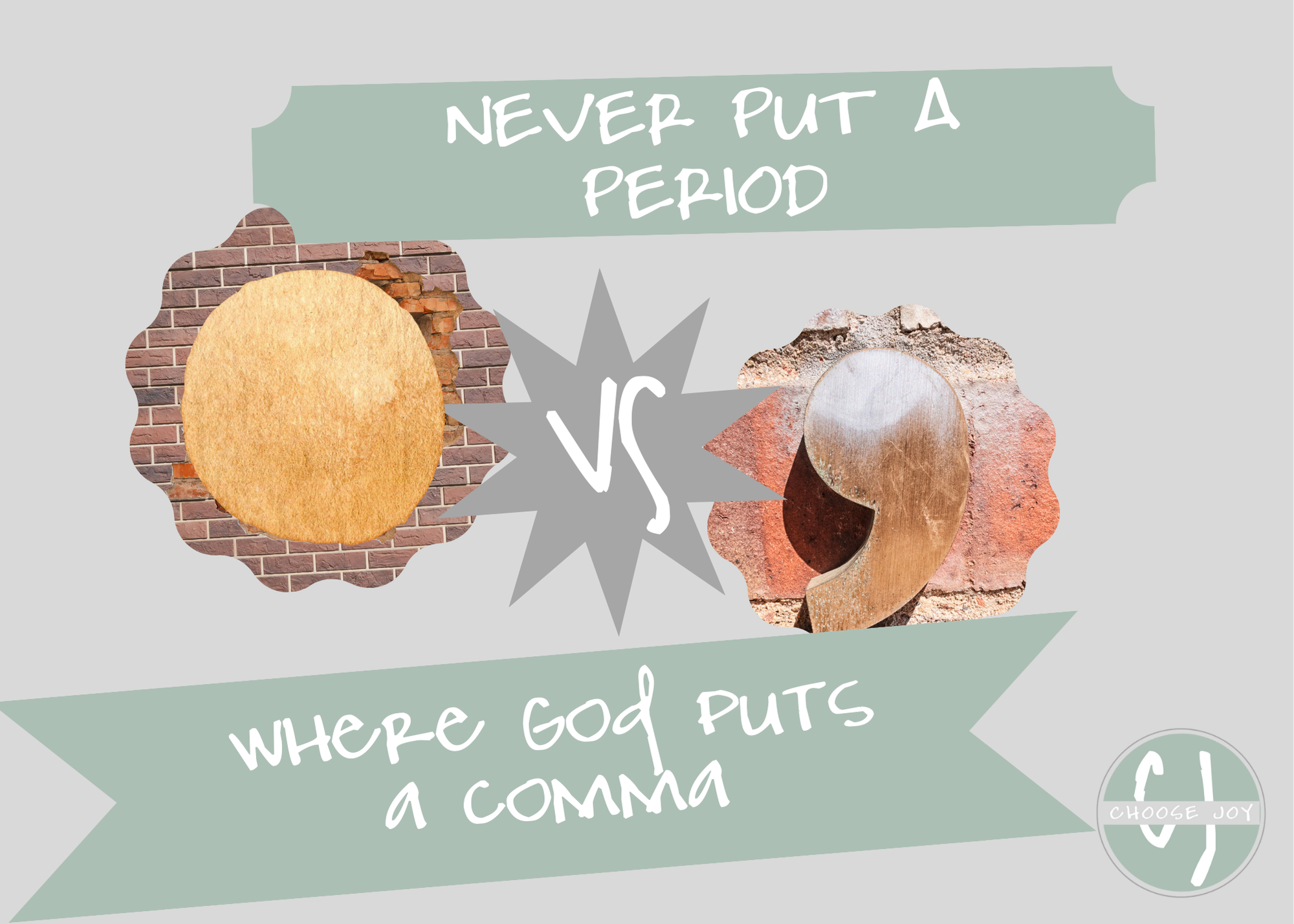
    “Never put a period where God has put a comma. God is still speaking.” – Gracie Allen

    Have you ever felt like your life was over, like there was no more hope, no more chances?

    Maybe you’ve faced a difficult diagnosis, a painful breakup, or a career-ending failure. In those moments, it’s easy to believe that God has put a period at the end of your story.

    But, are you still alive?

    If so, I’d like to encourage you. God didn’t put a period. Instead, He put a comma. If you are still alive, you still have living to do!

    He put a comma to indicate a pause, a breath, a new clause in the sentence of your life.

    This quote, “Never put a period where God puts a comma,” powerfully reminds us that our lives are not over. This is true even when it feels like they are.

    It’s a reminder that God is still writing our story. He has a plan to prosper us, not to harm us (Jeremiah 29:11).

    Let’s take a look at the story of Lazarus.

    In John 11, we read the story of Lazarus, a man who was sick and died. His sisters, Mary and Martha, were devastated. They hoped that Jesus would come and heal their brother. However, He didn’t arrive until after Lazarus had passed away.

    In their grief, Mary and Martha put a period at the end of Lazarus’ story. They believed that his life was over, and that there was no more hope.

    But Jesus came and said, “I am the resurrection and the life. The one who believes in me will live, even though they die” (John 11:25).

    And then, in one of the most amazing moments in all of Scripture, Jesus called out to Lazarus, “Come out!” (John 11:43). And Lazarus, who had been dead for four days, came out of the tomb, alive!

    This story is a powerful reminder that God doesn’t always put periods. Sometimes, He puts commas.

    And when He does, it means that there is more to come. There is more life to live. There is more hope to hold onto.

    Friend, If you’re feeling like your life is over, it may seem like there’s no more hope or chances. Remember, God doesn’t always put periods. He puts commas. And that means that there is always more to come, there is more life to live.

    Never put a period where God puts a comma.

    These are powerful words to live by. They remind us that our lives are not over, even when it feels like they are. God is still writing our story, and He has a plan to prosper us, not to harm us.

    I remember sitting with my sweet sister Sara during her last days here on earth. One of the last things she said was, “I want people to continue learning. Learning to believe and trust in God as I have tried to be God’s disciple. BUT,” she said, “it’s not about me. It’s about Him. That is the message I want people to hear.”

    Sara and God didn’t want to end this ministry. Event though He put a period on her life physically, the message needed to continue.

    She and God wanted to use a comma.

    It has been quite a journey. Sometimes it feels like God has put a period as I struggle to understand next steps. He has also shown me time and time again that it’s only a comma.

    My role is to be intentional. Be intentional in keeping an open mind, a humble heart, and faithful feet, to walk where HE leads.

    I encourage you, take a deep breath, my friend. Trust that God has more in store for you. He sometimes puts commas, not periods. And that means that there is always hope, always more life to live.

    Our role is to be intentional in remembering, this life is not about us. It’s not about our wants, needs, and desires. It is about Him. It’s about Him using us to fulfill His plan and purpose for us and this world.

    Stay tuned…more to come,

    With love and joy,

    Laura

  • A Beautiful Dance

    A Beautiful Dance

    The above picture is my dad and I dancing at my wedding.

    I grew up in a family that loves to dance. My mom and dad’s first date included dancing, and that tradition continued throughout their marriage. They were blessed with six kids, three boys and three girls. The birth order was boy, girl, boy, girl, boy, girl. My dad always said that it took a lot of talent to pull that off!

    Our Saturday nights together consisted of watching Lawrence Welk. We paired up with our dance partner. We danced through the house to the lively music! Oh, the memories of the “good old days.”

    I learned early on the importance in dance is that someone has to lead and the other has to follow. The leader must keep the partnership in time with the song. The dance partner’s job is to follow based on cues and signals from the one leading the dance.

    I think life is a dance. Sometimes we need to lead, and other times we need to follow.

    When we follow, we choose to honor the one who leads us.

    God commands us to honor others.

    This isn’t always easy because there are definitely times when we don’t necessarily respect the actions or decisions of others.

    I think honor is more about me and my heart than it is about the person I am honoring. I choose to have the heart of a servant. When I honor every person I cross paths with, the choice shapes everything I say and do.

    Most importantly we are called to honor God.

    …”Those who honor me I will honor, but those who despise me will be disdained.” 1 Samuel 2:30 (NIV)

    Without complete and genuine honor to God, it will be impossible to honor anyone else. So, this is where it starts. We are called to honor God in what we say, what we do, in our finances, in all things!

    God commands us to honor our parents.

    “Honor your father and your mother, so that you may live long in the land the Lord your God is giving you.” Exodus 20:12 (NIV)

    The command to honor our parents may seem easy to some. It is much more challenging for others who were raised in negative or abusive environments. Are all parents deserving of honor? No. Does God still command it? Yes.

    This is one of those times when we may find it hard to carry out that command to honor. So, I think we first have to check our own heart. We can choose not to think or speak ill of them, no matter what has happened. Forgive them for any offenses, and most importantly, pray for them. We can still honor them, even if we can’t be in relationship with them.

    God commands us to honor our spouse.

    “In the same way, you husbands must give honor to your wives. Treat your wife with understanding as you live together.” 1 Peter 3:7 (NLT)

    God has commanded honor within marriage for several reasons. Honoring marriage will bless the husband and the wife. It will also bless their children, grandchildren, and everyone else around them. Additionally, marriage is a symbol of Christ and the Church.

    When we honor God above all else, our life will be like a beautiful dance. Life will go much smoother if we take our cues. We need to get in rhythm with the music of life. Gracefully follow where He leads us.

    My friend, I know from experience. When I try to take over and lead my life, I get off rhythm. I stumble because I trip on my own two feet. I get frustrated and want to give up.

    God has been the greatest dance partner in my life. I choose to honor God by letting Him lead me through this journey of life. The dance is beautiful and smooth. It is filled with joy.

    I encourage you to Choose to honor God by letting Him lead you on your life journey too.

    He will be the best dance partner you’ve ever had.

    And it will be a beautiful dance!

    With love and joy,

    Laura