Blog

  • The Freedom of Forgiveness

    The Freedom of Forgiveness

    I learned a new word this week!

    Unrequited:

    1. not returned or reciprocated: unrequited love.
    2.not avenged or retaliated: an unrequited wrong.
    3.not repaid or satisfied.

    I’ve been thinking about forgiveness this Lenten season.

    Forgiveness is a concept that can be both beautiful and brutal, depending on the context. On one hand, forgiveness offers a chance for healing, restoration, and new beginnings. On the other hand, it can be a painful and difficult process, especially when faced with hurtful or traumatic experiences.

    As Christians, we’re called to forgive others just as God forgives us. But what does that really mean? How do we do it?

    In the Bible, forgiveness is a recurring theme that showcases God’s merciful nature. From the Psalms to the Gospels, we’re reminded that forgiveness is a fundamental aspect of God’s character.

    In Matthew 6:14-15, Jesus teaches us that our forgiveness from God is directly tied to our willingness to forgive others. This doesn’t mean that God’s forgiveness is conditional. Instead, our experience of His forgiveness is deepened when we extend forgiveness to others.

    For many of us, forgiveness is a struggle. Forgiving is letting go of and accepting what has been. When we forgive, does it mean that we are saying what was done to us is okay? Does it mean that we are saying they are right and we are wrong?

    I don’t think so.

    One of the hardest things about forgiveness is that it often feels unrequited. Whatever was done that requires forgiveness often leaves us broken or empty, and sometimes those feelings weren’t validated. And perhaps still aren’t.

    As much as our deepest desire is to sometimes retaliate for being hurt, that’s not what forgiveness is all about. Even when matters are resolved to the best of everyone’s abilities, the injured party may still feel unsatisfied. Unrequited.

    Being wronged hurts. Speaking forgiveness is sometimes easy. However, truly feeling it is often hard.

    It’s a feeling of deciding whether we’d rather be right or if we’d rather be happy. If we’d rather hold onto our righteous hurt, or if we’d rather extend grace. Let’s be honest, we’re human, it’s our impulse most of the time to hold on rather than leave ourselves unrequited.

    I was given a whole new clarity about forgiveness when I came across this phrase:

    Forgiveness is giving up the possibility of a better past.

    It makes sense, doesn’t it? We hold onto things because they are unrequited. Because they hurt us. Because they never should have happened in the first place. Because we want to go back to the time before we were hurt and make it not happen. We want a better past.

    But that’s not possible.

    Life happened.

    The possibility for a better past just doesn’t exist. But the possibility for a better future is available to each and every person who is still breathing.

    We can let go of the hurt and the anger. We can release the need to once again say, “But I was right!” Each of us can decide that our future will be better. We have the opportunity to make our future better than our past. And we have the opportunity to give someone else the grace to know that, too, by extending forgiveness.

    By doing as Christ has done for each of us over and over and over again.

    Imagine if He looked as us and said, “But I was right,” instead of, “But you are Mine.”

    Letting go of the possibility of a better past means that a better future is possible. However, it doesn’t always mean both people will choose that path. There are people in my life who I have forgiven, knowing the past cannot change. But some of those people choose to live out the same actions over and over. They have the possibility for a better future, but they are choosing not to take it.

    I can forgive them without walking back into unhealthy situations. I can forgive them, and still choose not to play the game. I hope someday they will choose a better future, and I will cheer them on if they do. In the meantime, I care about them from a distance. I think, just like God does with us, we can stay where we are when they move away. And still be here when they choose to come back.

    Saying I’ll forgive and forget isn’t practical, because I don’t think we can forget. I think forgiveness happens in us. It occurs when we do remember what had been done to us without feeling like we did when it happened. It becomes just a memory. It’s a past that can’t be changed for the better, followed by a future that can.

    I’ve learned that leaving things unrequited can be a beautiful gift. It means they can be left where they belong so forgiveness can be given, received and cherished.

    With love and joy,

    Laura
    Fediverse reactions
  • All about the Comma

    All about the Comma

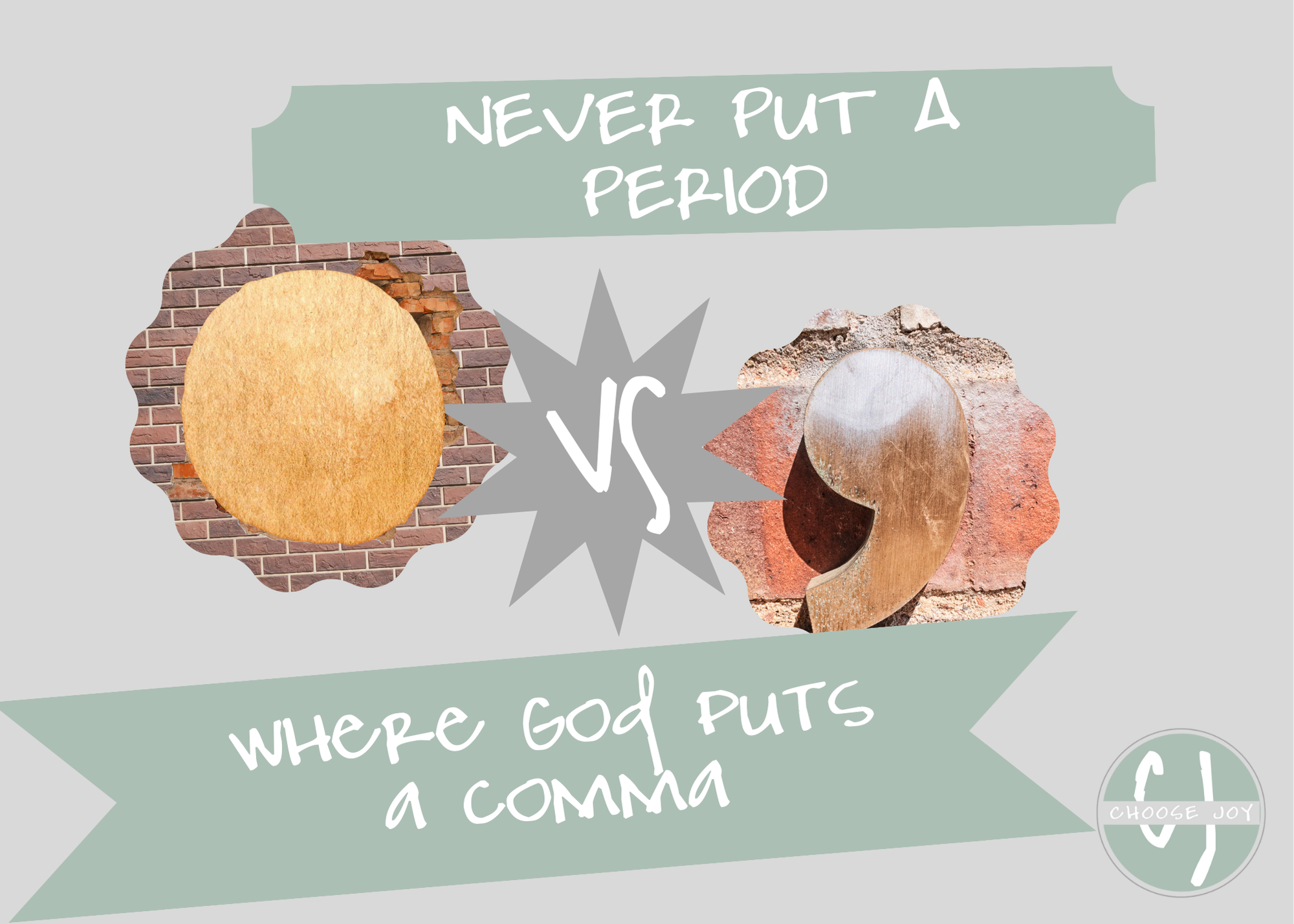
    “Never put a period where God has put a comma. God is still speaking.” – Gracie Allen

    Have you ever felt like your life was over, like there was no more hope, no more chances?

    Maybe you’ve faced a difficult diagnosis, a painful breakup, or a career-ending failure. In those moments, it’s easy to believe that God has put a period at the end of your story.

    But, are you still alive?

    If so, I’d like to encourage you. God didn’t put a period. Instead, He put a comma. If you are still alive, you still have living to do!

    He put a comma to indicate a pause, a breath, a new clause in the sentence of your life.

    This quote, “Never put a period where God puts a comma,” powerfully reminds us that our lives are not over. This is true even when it feels like they are.

    It’s a reminder that God is still writing our story. He has a plan to prosper us, not to harm us (Jeremiah 29:11).

    Let’s take a look at the story of Lazarus.

    In John 11, we read the story of Lazarus, a man who was sick and died. His sisters, Mary and Martha, were devastated. They hoped that Jesus would come and heal their brother. However, He didn’t arrive until after Lazarus had passed away.

    In their grief, Mary and Martha put a period at the end of Lazarus’ story. They believed that his life was over, and that there was no more hope.

    But Jesus came and said, “I am the resurrection and the life. The one who believes in me will live, even though they die” (John 11:25).

    And then, in one of the most amazing moments in all of Scripture, Jesus called out to Lazarus, “Come out!” (John 11:43). And Lazarus, who had been dead for four days, came out of the tomb, alive!

    This story is a powerful reminder that God doesn’t always put periods. Sometimes, He puts commas.

    And when He does, it means that there is more to come. There is more life to live. There is more hope to hold onto.

    Friend, If you’re feeling like your life is over, it may seem like there’s no more hope or chances. Remember, God doesn’t always put periods. He puts commas. And that means that there is always more to come, there is more life to live.

    Never put a period where God puts a comma.

    These are powerful words to live by. They remind us that our lives are not over, even when it feels like they are. God is still writing our story, and He has a plan to prosper us, not to harm us.

    I remember sitting with my sweet sister Sara during her last days here on earth. One of the last things she said was, “I want people to continue learning. Learning to believe and trust in God as I have tried to be God’s disciple. BUT,” she said, “it’s not about me. It’s about Him. That is the message I want people to hear.”

    Sara and God didn’t want to end this ministry. Event though He put a period on her life physically, the message needed to continue.

    She and God wanted to use a comma.

    It has been quite a journey. Sometimes it feels like God has put a period as I struggle to understand next steps. He has also shown me time and time again that it’s only a comma.

    My role is to be intentional. Be intentional in keeping an open mind, a humble heart, and faithful feet, to walk where HE leads.

    I encourage you, take a deep breath, my friend. Trust that God has more in store for you. He sometimes puts commas, not periods. And that means that there is always hope, always more life to live.

    Our role is to be intentional in remembering, this life is not about us. It’s not about our wants, needs, and desires. It is about Him. It’s about Him using us to fulfill His plan and purpose for us and this world.

    Stay tuned…more to come,

    With love and joy,

    Laura

    Fediverse reactions
  • A Beautiful Dance

    A Beautiful Dance

    The above picture is my dad and I dancing at my wedding.

    I grew up in a family that loves to dance. My mom and dad’s first date included dancing, and that tradition continued throughout their marriage. They were blessed with six kids, three boys and three girls. The birth order was boy, girl, boy, girl, boy, girl. My dad always said that it took a lot of talent to pull that off!

    Our Saturday nights together consisted of watching Lawrence Welk. We paired up with our dance partner. We danced through the house to the lively music! Oh, the memories of the “good old days.”

    I learned early on the importance in dance is that someone has to lead and the other has to follow. The leader must keep the partnership in time with the song. The dance partner’s job is to follow based on cues and signals from the one leading the dance.

    I think life is a dance. Sometimes we need to lead, and other times we need to follow.

    When we follow, we choose to honor the one who leads us.

    God commands us to honor others.

    This isn’t always easy because there are definitely times when we don’t necessarily respect the actions or decisions of others.

    I think honor is more about me and my heart than it is about the person I am honoring. I choose to have the heart of a servant. When I honor every person I cross paths with, the choice shapes everything I say and do.

    Most importantly we are called to honor God.

    …”Those who honor me I will honor, but those who despise me will be disdained.” 1 Samuel 2:30 (NIV)

    Without complete and genuine honor to God, it will be impossible to honor anyone else. So, this is where it starts. We are called to honor God in what we say, what we do, in our finances, in all things!

    God commands us to honor our parents.

    “Honor your father and your mother, so that you may live long in the land the Lord your God is giving you.” Exodus 20:12 (NIV)

    The command to honor our parents may seem easy to some. It is much more challenging for others who were raised in negative or abusive environments. Are all parents deserving of honor? No. Does God still command it? Yes.

    This is one of those times when we may find it hard to carry out that command to honor. So, I think we first have to check our own heart. We can choose not to think or speak ill of them, no matter what has happened. Forgive them for any offenses, and most importantly, pray for them. We can still honor them, even if we can’t be in relationship with them.

    God commands us to honor our spouse.

    “In the same way, you husbands must give honor to your wives. Treat your wife with understanding as you live together.” 1 Peter 3:7 (NLT)

    God has commanded honor within marriage for several reasons. Honoring marriage will bless the husband and the wife. It will also bless their children, grandchildren, and everyone else around them. Additionally, marriage is a symbol of Christ and the Church.

    When we honor God above all else, our life will be like a beautiful dance. Life will go much smoother if we take our cues. We need to get in rhythm with the music of life. Gracefully follow where He leads us.

    My friend, I know from experience. When I try to take over and lead my life, I get off rhythm. I stumble because I trip on my own two feet. I get frustrated and want to give up.

    God has been the greatest dance partner in my life. I choose to honor God by letting Him lead me through this journey of life. The dance is beautiful and smooth. It is filled with joy.

    I encourage you to Choose to honor God by letting Him lead you on your life journey too.

    He will be the best dance partner you’ve ever had.

    And it will be a beautiful dance!

    With love and joy,

    Laura

    Fediverse reactions
  • Where is God in the Shadows?

    Where is God in the Shadows?

    Jesus did not come to explain away suffering or remove it. He came to fill it with His presence. ~Paul Claudel

    We have many questions when we face difficult and tragic situations. One of the biggest is: “Why do bad things happen to good people.”

    A natural response when bad things are happening, is why? If God is good and all powerful, why doesn’t He stop the pain and suffering?

    God sits with us in our sadness. Accompanies us through the valley of the shadows. Holds our hand in our moments of fear.

    Suffering will look different for every believer in Jesus Christ. However, the desired end result should look the same when following Christ. 1Peter 4:12-13 MSG says, 

    “Friends, when life gets really difficult, don’t jump to the conclusion that God isn’t on the job. Instead, be glad that you are in the very thick of what Christ experienced. This is a spiritual refining process, with glory just around the corner.” 

    When I choose to let Him, God fills me with His presence in my spirit. I can feel strong in the middle of that weakness.

    Emotionally, it’s called a pit of despair for a reason. A hole can be dug inside us so deep that it seems everything good has been excavated from our lives.

    We all experience it in different ways. You may have lost someone you love. Or you may have found yourself in situations you never dreamed you would be facing.

    A pit is dug. And despair is the first visitor that wants to knock at your door.

    It’s in those moments I pray for God to get me out of His way. It’s those moments when I start praying for Him to change my heart for what He wants. Pray that I can be aware of the opportunities He has planned for me.

    It’s taken me a while, but I realize, this life is not about me. It’s not about my wants and desires. It is about Him. It’s about me saying yes to what He can do through me.

    It requires me to trust Him completely. It doesn’t change the loss. It doesn’t improve my earthly situation.

    But it does change the suffering.

    It allows me to not answer the door to despair and instead invite His presence into the pit. The pit looks jagged and deep. It turns out to be a God-shaped hole in the center of our beings. A hole that is dug by circumstances and choices, and we can choose to fill it with His grace.

    We all live in a place of unknown realities. He has ensured that we don’t have to suffer.

    We get to choose whether to trust Him. Then, ask Him to show us how He wants to use us.

    Then, say yes.

    With love and joy,

    Laura

    Fediverse reactions
  • The Luck of the Irish: Finding Blessings Beyond the Blarney Stone

    As we celebrate St. Patrick’s Day, many of us will be donning green attire, searching for four-leaf clovers, and perhaps even kissing the Blarney Stone in hopes of securing a wee bit of good fortune. But as Christians, we know that our blessings come from a much higher source than a pot of gold at the end of a rainbow.

    While St. Patrick’s Day has become synonymous with all things Irish, it’s essential to remember the real story behind this beloved saint. Patrick, a humble Christian missionary, was instrumental in spreading the Gospel to the Emerald Isle. His unwavering faith and commitment to sharing God’s love with the Irish people had a profound impact on their lives and culture.

    As we reflect on the concept of “luck,” we’re reminded that our blessings come from God’s sovereign hand.

    Jeremiah 29:11, we’re told, “For I know the plans I have for you,” declares the Lord, “plans to prosper you and not to harm you, plans to give you hope and a future.”

    This promise reassures us that our lives are not governed by chance or fate, but by a loving God who desires to bless and prosper us.

    So, what does it mean to experience good fortune as a Christian? Is it merely a matter of chance or coincidence? Absolutely not!

    When we acknowledge God as the source of all blessings, we begin to see that every good thing in our lives is a direct result of His loving providence.

    In Deuteronomy 8:17-18, Moses cautions the Israelites against attributing their success to their own strength or abilities, reminding them that it is God who gives them the power to prosper. This same principle applies to our lives today. When we recognize God’s hand in our blessings, we’re compelled to give thanks and glory to Him, rather than relying on luck or our own efforts.

    As we celebrate St. Patrick’s Day, let’s not get caught up in the notion of relying on luck or chance for our blessings. Instead, let’s fix our eyes on the One who is the source of all good things. May we, like St. Patrick, be faithful in sharing God’s love with others and trusting in His sovereign providence to guide our lives.

    How can you, like St. Patrick, share God’s love with others and trust in His sovereign providence to guide your life?

    With love and joy,

    Laura

    Fediverse reactions