
A reflection on James 1:2-4
"Consider it pure joy...whenever you face trials of many kinds." - James 1:2-4
With my motto being ‘Choose Joy,’ I receive a lot of questions about how this is possible. I hear from individuals comments like, “My feelings are my feelings, how can I just choose joy?”
These comments and questions are very appropriate, and I pray that this post brings clarity and definition to the phrase “Choose Joy.”
At first glance, James’ words feel almost impossible. Joy and trials don’t seem like they belong in the same sentence, let alone the same experience. When life feels heavy, confusing, or painful, joy often feels out of reach. And yet, James doesn’t say feel joy—he says consider it.
That one word changes everything.
First, let’s look at Finding Joy vs. Discovering Joy.
There’s a difference between finding joy and discovering joy.
Finding joy implies we stumble upon something pleasant—something that makes us smile or brings relief. Discovering joy, however, suggests something deeper. It means uncovering what God is already doing beneath the surface, even when circumstances are hard.
James isn’t telling us to enjoy the trial. He’s inviting us to discover joy within it—by recognizing what God is producing through it.
Now let’s tackle Trials vs. Temptation.
It’s important to distinguish between trials and temptation. Trials are the pressures and challenges we face in a broken world—loss, uncertainty, waiting, disappointment. Temptation, on the other hand, tries to pull us away from God’s truth and character.
Trials test our faith.
Temptation tests our obedience.
God does not tempt us, but He does allow trials—and He never wastes them. James tells us that trials produce perseverance, and perseverance matures us, making us “complete, not lacking anything.”
Resistance vs. Acceptance.
Our natural response to difficulty is resistance. We fight the situation, replay it in our minds, or carry the weight of “I need to deal with this.” But resistance often leaves us exhausted and discouraged.
Acceptance doesn’t mean approval or denial of pain. It means shifting the burden from “I need to fix this” to “God needs to deal with this.” Acceptance says, Lord, I don’t understand this, but I trust You are at work.
That shift is often where joy begins to grow.
Joy vs. Pleasure
Joy is not the same as pleasure. Pleasure depends on circumstances—it fades when comfort disappears. Joy is rooted in confidence that God is present, purposeful, and faithful.
Joy does not mean the absence of sadness. You can grieve and still have joy. You can feel overwhelmed and still walk in joy. Joy is not pretending everything is okay; it’s choosing to believe God is still good.
Joy Is a Focus, Not a Feeling.
This is where James’ instruction becomes practical. We cannot choose our feelings. Feelings come and go, often without our permission. But we can choose our focus.
Joy is not something we wait to feel—it’s something we choose to focus on.
We may not feel joyful in the middle of a trial, but we can focus on:
- What God is teaching us
- How God is strengthening our faith
- The promise that this season is producing something eternal
That focus doesn’t deny pain—it redeems it.
You Can Have Joy Without Feeling It.
James doesn’t ask us to manufacture emotions. He invites us to adopt a perspective shaped by trust. Joy is an act of faith before it ever becomes a feeling.
When we choose to see trials through God’s lens instead of our own, joy quietly takes root. Not loud. Not forced. But steady and deep.
And over time, we discover that what once felt unbearable has become a place of growth, maturity, and grace.
Joy isn’t found when the trial ends.
Joy is discovered when we trust God within it.
Choose Joy defined:
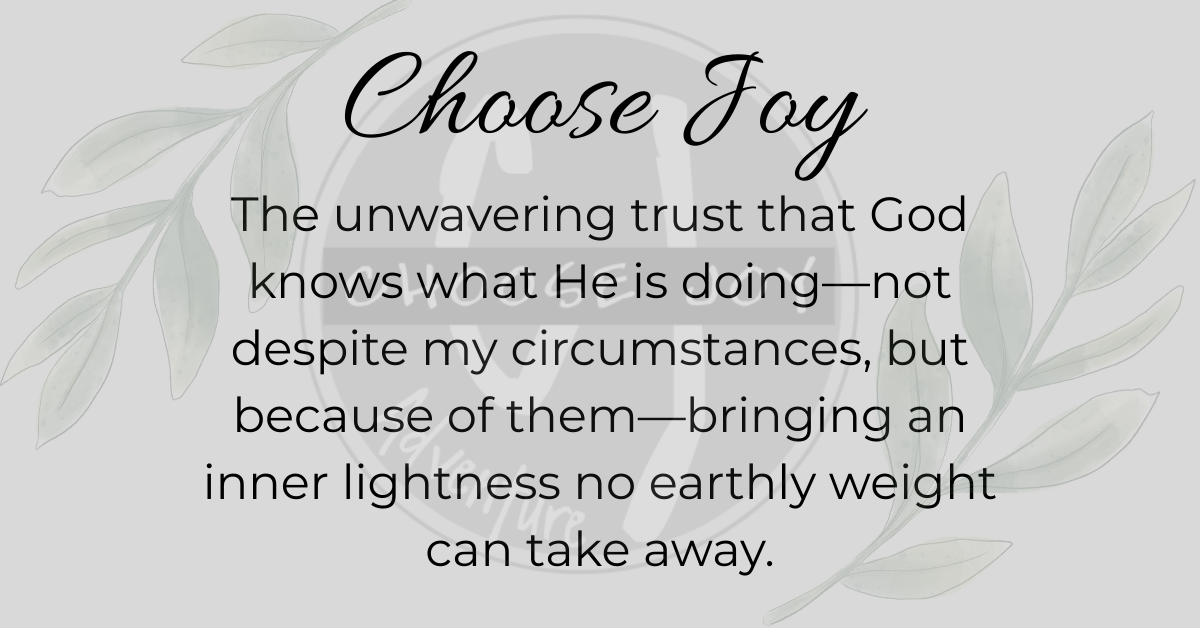
The unwavering trust that God knows what He is doing – not despite my circumstances, but because of them – bringing an inner lightness not earthly weight can take away.
With love and joy,
Laura
Leave a Reply