Category: loss

  • By Grace Alone: The Power of Abiding

    By Grace Alone: The Power of Abiding

    My sister Sara had this By Grace Alone necklace, pictured above, and she also gifted me one. Grace is the power of God to do for us what we cannot do for ourselves.

    She wanted us both to remember that when life feels out of control, we shouldn’t try to control it. We should surrender it to God, who is in control.

    What I have found is that the harder I try to control a situation, the more anxiety and fear control me. But when I let go and let God control the outcomes, I feel His perfect peace.

    If grace is the foundation of our faith, then abiding is the way we live it out.

    When Jesus says in John 15:5, “…without Me you can do nothing,” He doesn’t leave us there in helplessness—He immediately invites us into something deeper: “Abide in Me, and I in you.” This is not a command rooted in pressure, but an invitation rooted in relationship.

    To abide means to remain, to stay, to dwell.

    It’s not a striving word—it’s a staying word.

    So often, we approach our walk with God like a performance. We try harder, do more, fix ourselves, prove our devotion. But abiding shifts the focus entirely. It calls us away from self-effort and into constant connection.

    Think about a branch on a vine. The branch doesn’t strain to produce fruit. It doesn’t wake up each day determined to be more fruitful. It simply stays connected. Everything it needs flows from the vine—nutrients, strength, life itself.

    Jesus is reminding us: You are the branch. I am the source.

    Abiding is choosing connection over control.

    It looks like:

    • Turning your thoughts back to God throughout the day
    • Sitting with His Word, not just to check a box, but to hear His voice
    • Praying honestly, not perfectly
    • Surrendering your worries instead of trying to manage everything on your own
    • Trusting Him in the in-between, not just in the breakthrough

    Abiding is less about a moment and more about a posture.

    It’s waking up aware that you need Him.
    It’s walking through your day dependent on Him.
    It’s ending your day resting in Him.

    And here’s the beautiful truth: abiding is where grace becomes tangible.

    When you abide, you begin to experience the very power of God working in you—doing what you could never do on your own. That patience you didn’t have? It grows. That peace that made no sense? It settles in. That strength when you felt weak? It shows up.

    Not because you manufactured it—but because you remained connected to the One who supplies it.

    Abiding also means trusting that God is at work even when you don’t feel it.

    A branch doesn’t see the inner workings of the vine, but growth is still happening. In the same way, there are seasons where God feels quiet, distant, or unseen. But abiding says, “I will stay anyway. I will trust that You are still moving, still shaping, still providing.”

    This is where many people struggle—not in starting with God, but in staying with Him.

    But abiding is not about perfection; it’s about returning.

    Every time your mind wanders—come back.
    Every time you feel distant—draw near again.
    Every time you try to take control—release it back to Him.

    Grace makes abiding possible, and abiding keeps us positioned to receive grace.

    So instead of asking, “What more do I need to do?”
    Maybe the better question is, “Where do I need to stay?”

    Stay connected.
    Stay surrendered.
    Stay aware of His presence.

    Because by grace alone, you are sustained—and through abiding, you experience it every single day.

    With love and joy,

    Laura
  • Choosing Joy Does Not Negate Sadness

    Choosing Joy Does Not Negate Sadness

    Finding God’s presence in both tears and praise

    There is a misunderstanding that often slips into Christian life—the belief that if we are truly choosing joy, we should not feel sadness. We may think that joy means smiling through everything, staying positive no matter what, and never letting grief show. But that is not the kind of joy God invites us into.

    Choosing joy does not mean denying pain.
    Choosing joy means inviting God into it.

    Joy and sorrow can exist at the same time.

    This is a misconception I struggled with for years after beginning my Choose Joy Adventure. I held the burden of swallowing my sadness when others were around. If I were going to be the “face of choose joy,” I couldn’t let others see me sad. Showing sadness would make me a hypocrite…so I thought.

    Scripture never tells us that following Christ removes sadness. In fact, the Bible is full of people who loved God deeply and still wept, mourned, and wrestled with heavy emotions.

    Jesus Himself felt sorrow.

    “Jesus wept.” — John 11:35

    In that moment, Jesus knew He was about to raise Lazarus from the dead, yet He still cried. His tears were not a lack of faith. They were love. They were compassion. They were proof that holiness does not remove human emotion.

    Joy is not the absence of sadness.
    Joy is the presence of God in the middle of sadness.

    Choosing joy means choosing truth over denial.

    Sometimes we think choosing joy means saying,
    “I’m fine.”
    “It’s all good.”
    “It doesn’t hurt.”

    But real joy is not pretending.
    Real joy is trusting.

    Joy says:
    This hurts… but God is still good.
    I don’t understand… but God is still with me.
    I feel broken… but I am not abandoned.

    “Weeping may endure for a night, but joy comes in the morning.” — Psalm 30:5

    Notice the verse does not say weeping never comes.
    It says weeping has a season, but it does not have the final word.

    God never asks us to choose joy by ignoring our hearts.

    God created our emotions.
    He is not afraid of them.

    The Psalms are filled with cries of confusion, fear, anger, and grief. Yet they are also filled with praise. The same person can write both in the same prayer. That is the life of faith.

    Choosing joy is not pushing sadness away.
    It is bringing sadness to God instead of carrying it alone.

    “The Lord is close to the brokenhearted and saves those who are crushed in spirit.” — Psalm 34:18

    If broken hearts kept us from joy, God would not come near to them. But the opposite is true — He comes closer.

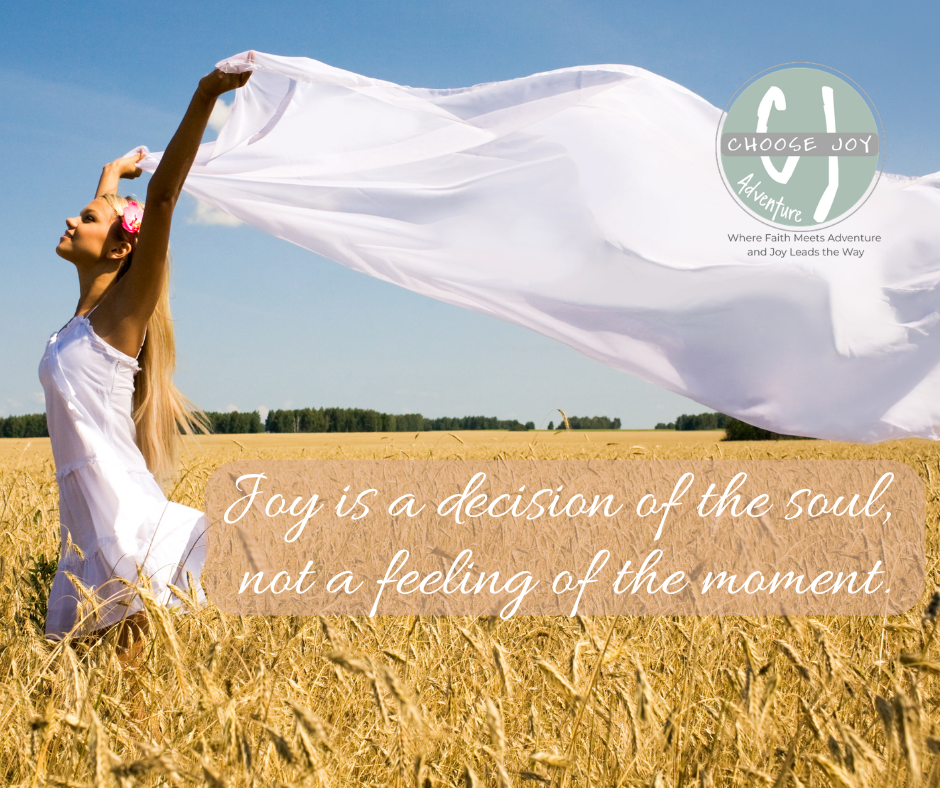
    Joy is a decision of the soul, not a feeling of the moment.

    Feelings change.
    Circumstances change.
    Seasons change.

    Joy is deeper than all of those.

    Joy is the quiet confidence that God is still working, even when life feels heavy.

    You can choose joy while crying.
    You can choose joy while healing.
    You can choose joy while waiting.
    You can choose joy while grieving.

    Because joy is not saying,
    “This doesn’t hurt.”

    Joy is saying,
    “This hurts, but God is still faithful.”

    Choosing joy means trusting that sadness is not wasted.

    God never wastes tears.
    He never ignores pain.
    He never walks away from a hurting heart.

    Sometimes the very place where we feel the most sadness becomes the place where we experience the deepest peace, because that is where we learn to lean on Him.

    Joy grows in places where we thought only sorrow could live.

    “Those who sow with tears will reap with songs of joy.” — Psalm 126:5

    Tears are not the opposite of joy.
    Sometimes they are the soil where joy begins.

    If your heart feels heavy right now, you are not failing at choosing joy. You are human. And God is right there with you.

    Choosing joy does not mean you stop feeling sadness.
    It means sadness does not get to decide your hope.

    Joy is not the denial of pain.
    Joy is the decision to trust God in the middle of it.

    Praying for each of you to find joy today…even in the sadness.

    With love and joy,

    Laura

  • Catch and Release — Choose Joy Adventure

    Catch and Release — Choose Joy Adventure

    One of the things I love about my Choose Joy Adventure is that it reminds me life with God is not a straight path — it’s a journey. Sometimes it feels like a peaceful walk along the shore… and other times it feels like standing at the edge of the water, holding something I worked hard to catch, knowing God is asking me to release it.

    “Catch and release” is a phrase often used in fishing. There are places and times where, after you catch a fish, you are required to release it back into the water. The purpose is growth. The fish population grows stronger because not every catch is kept.

    Catch means to secure something.
    Release means to set it free.

    If I’m honest, releasing is hard — especially after I’ve worked so hard to catch something. Just like fishing, there are seasons of waiting in life. Seasons where I’ve stood still for a long time, watching, hoping, praying, waiting to feel that little nibble that tells me something is finally happening.

    Waiting for the moment I can set the hook.
    Waiting to reel in the big one.
    Waiting for the breakthrough I prayed for.

    And then… sometimes God asks me to let it go.

    I have had to release jobs I worked hard to achieve.
    Release long-time friendships because life has changed.
    Release goals because of health struggles.
    Release expectations because life didn’t turn out the way I thought it would.

    In those moments, it didn’t feel like an adventure.
    It felt like a loss.
    It felt like failure.
    It felt like I had done something wrong.

    But the more I walk this Choose Joy journey, the more I am learning something powerful:

    God is not trying to take from me —He is growing me.

    Psalm 55:22 (NIV) says,

    “Cast your cares on the Lord and He will sustain you;
    He will never let the righteous be shaken.”

    To cast means to release.

    Sometimes the most courageous step in the adventure is not holding tighter…it’s letting go.

    There are two things we can count on in life:
    God never changes, and life always will.

    Change is inevitable.
    Growth is intentional.
    ~ Glenda Cloud

    So the question becomes —
    Will I fight the change…or will I grow through it?

    On this Choose Joy Adventure, I am learning there is a difference between giving up and letting go.

    Giving up says,
    “I lost.”

    Letting go says,
    “God has something more.”

    Just like releasing the fish so it can grow, sometimes God asks me to release what I thought I needed… so He can grow something deeper in me.

    I am not defeated.
    I am being developed.

    I can look back and be thankful for the seasons where I caught something wonderful — the job, the friendship, the opportunity, the dream. Those were real gifts.

    But I am also learning to trust that when God asks me to release something, it is because the adventure is not over yet.

    Through the eyes of faith, I can say yes to the next step, even when I don’t understand it.

    2 Corinthians 5:17 (ESV) reminds us,

    “Therefore, if anyone is in Christ, he is a new creation.
    The old has passed away; behold, the new has come.”

    New seasons require open hands.

    And the greatest example of release is this —
    God released His Son for us.

    Because of Jesus, we have the freedom to release fear, doubt, disappointment, and regret.

    So if you find yourself holding something today that God is asking you to release…you are not failing.

    Because of Jesus, we can choose joy even when life changes.
    Because of Jesus, every ending can become the beginning of a new adventure.

    You are stepping deeper into the journey.

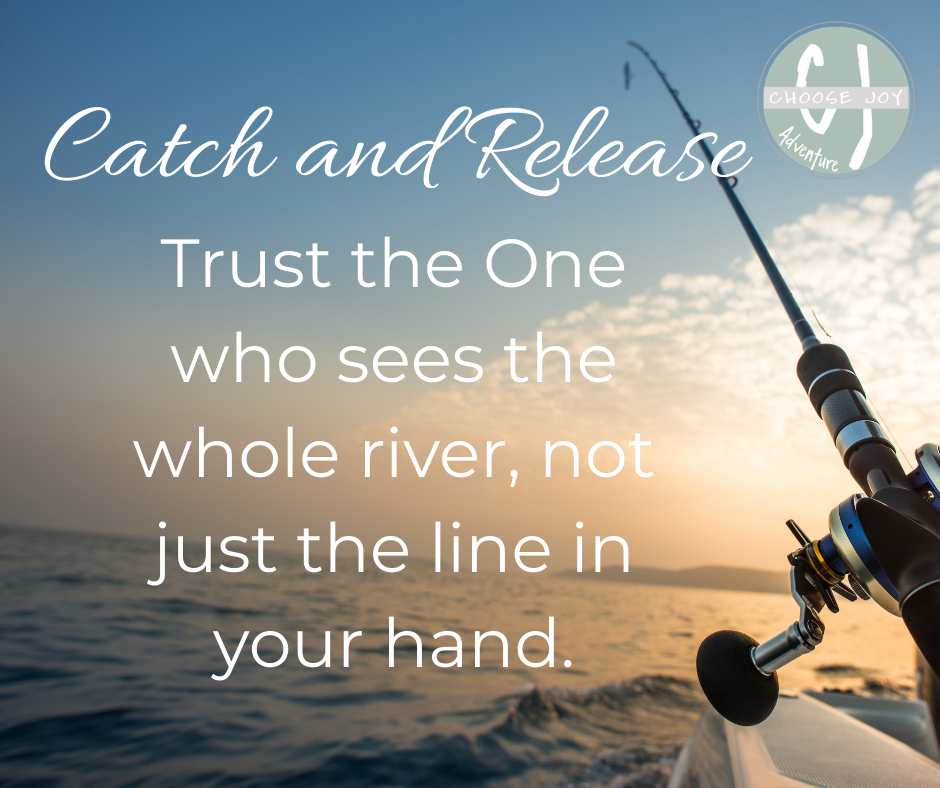
    My friend, in life’s adventures, you will be asked to trust the One who sees the whole river, not just the line in your hand.

    Catch.
    Release.
    Trust.
    Grow.
    Choose Joy.

    With love and joy,

    Laura

  • Discovering Joy When Life is Hard

    Discovering Joy When Life is Hard

    A reflection on James 1:2-4

    "Consider it pure joy...whenever you face trials of many kinds." - James 1:2-4

    With my motto being ‘Choose Joy,’ I receive a lot of questions about how this is possible. I hear from individuals comments like, “My feelings are my feelings, how can I just choose joy?”

    These comments and questions are very appropriate, and I pray that this post brings clarity and definition to the phrase “Choose Joy.”

    At first glance, James’ words feel almost impossible. Joy and trials don’t seem like they belong in the same sentence, let alone the same experience. When life feels heavy, confusing, or painful, joy often feels out of reach. And yet, James doesn’t say feel joy—he says consider it.

    That one word changes everything.

    First, let’s look at Finding Joy vs. Discovering Joy.

    There’s a difference between finding joy and discovering joy.
    Finding joy implies we stumble upon something pleasant—something that makes us smile or brings relief. Discovering joy, however, suggests something deeper. It means uncovering what God is already doing beneath the surface, even when circumstances are hard.

    James isn’t telling us to enjoy the trial. He’s inviting us to discover joy within it—by recognizing what God is producing through it.

    Now let’s tackle Trials vs. Temptation.

    It’s important to distinguish between trials and temptation. Trials are the pressures and challenges we face in a broken world—loss, uncertainty, waiting, disappointment. Temptation, on the other hand, tries to pull us away from God’s truth and character.

    Trials test our faith.
    Temptation tests our obedience.

    God does not tempt us, but He does allow trials—and He never wastes them. James tells us that trials produce perseverance, and perseverance matures us, making us “complete, not lacking anything.”

    Resistance vs. Acceptance.

    Our natural response to difficulty is resistance. We fight the situation, replay it in our minds, or carry the weight of “I need to deal with this.” But resistance often leaves us exhausted and discouraged.

    Acceptance doesn’t mean approval or denial of pain. It means shifting the burden from “I need to fix this” to “God needs to deal with this.” Acceptance says, Lord, I don’t understand this, but I trust You are at work.

    That shift is often where joy begins to grow.

    Joy vs. Pleasure

    Joy is not the same as pleasure. Pleasure depends on circumstances—it fades when comfort disappears. Joy is rooted in confidence that God is present, purposeful, and faithful.

    Joy does not mean the absence of sadness. You can grieve and still have joy. You can feel overwhelmed and still walk in joy. Joy is not pretending everything is okay; it’s choosing to believe God is still good.

    Joy Is a Focus, Not a Feeling.

    This is where James’ instruction becomes practical. We cannot choose our feelings. Feelings come and go, often without our permission. But we can choose our focus.

    Joy is not something we wait to feel—it’s something we choose to focus on.

    We may not feel joyful in the middle of a trial, but we can focus on:

    • What God is teaching us
    • How God is strengthening our faith
    • The promise that this season is producing something eternal

    That focus doesn’t deny pain—it redeems it.

    You Can Have Joy Without Feeling It.

    James doesn’t ask us to manufacture emotions. He invites us to adopt a perspective shaped by trust. Joy is an act of faith before it ever becomes a feeling.

    When we choose to see trials through God’s lens instead of our own, joy quietly takes root. Not loud. Not forced. But steady and deep.

    And over time, we discover that what once felt unbearable has become a place of growth, maturity, and grace.

    Joy isn’t found when the trial ends.
    Joy is discovered when we trust God within it
    .

    Choose Joy defined:

    The unwavering trust that God knows what He is doing – not despite my circumstances, but because of them – bringing an inner lightness not earthly weight can take away.

    With love and joy,

    Laura

  • Confidence Through Christ

    Confidence Through Christ

    Trusting God’s Work When Life Feels Unfinished

    “Being confident of this, that He who began a good work in you will carry it on to completion until the day of Christ Jesus.” — Philippians 1:6

    Confidence is something many of us are chasing—confidence in our decisions, our purpose, our calling, and even ourselves. Yet in today’s world, confidence feels fragile. One unexpected bill, one hard conversation, one setback at work, or one glance at social media can shake it all.

    We are surrounded by messages telling us to “believe in yourself,” “trust your instincts,” and “have confidence in your abilities.” While encouragement has its place, self-based confidence often crumbles under pressure.

    Life is unpredictable, exhausting, and sometimes overwhelming. That’s why Scripture points us toward a different source of confidence—confidence through Christ.

    Confidence That Doesn’t Depend on Circumstances.

    Philippians 1:6 reminds us that our confidence is not rooted in how well we are doing, but in who God is and what He is doing. Paul doesn’t say, “Be confident because you’re strong enough,” or “Be confident because life will go smoothly.” Instead, he says we can be confident because God finishes what He starts.

    That truth matters deeply in today’s life circumstances.

    • When you’re juggling work, family, and responsibilities and feel like you’re falling short.
    • When you’re waiting for healing, clarity, or provision that hasn’t come yet.
    • When your faith feels small, your energy is low, and your progress feels slow.

    God is not surprised by the mess, the delays, or the unfinished parts of your story. He is still working—even when you can’t see it.

    Let’s be honest: many of us are walking through seasons that don’t look very “Instagram-worthy.” We’re navigating stress, anxiety, broken relationships, uncertainty about the future, and questions we never expected to ask. Confidence in Christ doesn’t mean pretending everything is okay. It means trusting God in the middle of what isn’t okay.

    Confidence through Christ looks like:

    • Showing up even when you feel unqualified
    • Taking the next step even when you don’t have the full picture
    • Trusting God’s process even when progress feels painfully slow

    It’s the quiet assurance that God’s work in you is deeper than your current situation.

    You Are a Work in Progress—And That’s Good News. He is working to transform you, if you are willing to let Him.

    One of the most freeing truths of Philippians 1:6 is that completion is God’s responsibility, not ours. We are often frustrated by how far we still have to go, but God is faithful in every stage of growth. The waiting, the stretching, the refining—it’s all part of the good work He began.

    Your confidence doesn’t come from being “finished.”
    It comes from knowing you are not abandoned.

    God is shaping your character, strengthening your faith, and preparing you for what’s ahead—even through the challenges you wish away.

    Confidence through Christ is a daily choice. It’s choosing to trust God when doubt whispers loudly. It’s anchoring your heart in truth instead of fear. It’s reminding yourself that your story is still being written.

    So today, wherever you find yourself:

    • If you feel behind, God is not done.
    • If you feel weak, God is still working.
    • If you feel uncertain, God remains faithful.

    Be confident—not in yourself—but in Christ, who is faithful to complete the work He began in you.

    A guided prayer for you:

    Lord, thank You for being faithful even when I struggle to believe it. Help me place my confidence in You, not in my circumstances or my abilities. Remind me that You are still working, still shaping, and still guiding my life. I trust You with what feels unfinished. Amen.

    With love and joy,

    Laura