Category: Uncategorized

  • Identity in Christ — You Are God’s Masterpiece

    Identity in Christ — You Are God’s Masterpiece

    “For we are God’s masterpiece. He has created us anew in Christ Jesus, so we can do the good things He planned for us long ago.”Ephesians 2:10 (NLT)

    Have you ever asked, “Who am I, really?

    Most of us spend years trying to answer that question through what we do, what others think, or what we’ve been through. But as Jamie Winship teaches, the truest thing about you is what God says about you.

    You are not your job, your past, your successes, or your struggles. You are God’s masterpiece. He designed you on purpose, for purpose — not to prove your worth, but to live from the worth He’s already given you in Christ.

    Living From Identity, Not For Identity

    I have been listening and reading from Jamie Winship and he often says that most of us live for identity — constantly striving to be seen as successful, good enough, loved, or valuable. But in Christ, we are invited to live from identity — a place of rest, freedom, and peace that comes from knowing who we already are.

    When you live for identity, life feels like performance. When you live from identity, life becomes partnership — walking with the One who created you to do “the good things He planned for you long ago.”

    Your identity in Christ is not earned; it’s received. It’s not a goal to achieve; it’s a gift to embrace.

    Hearing God’s Voice About Who You Are

    Jamie Winship encourages believers to ask God directly:

    “Lord, who do You say I am?”

    It’s a simple, yet life-changing prayer. God loves to reveal how He sees you — unique, loved, courageous, creative, joyful, chosen. These aren’t just nice affirmations; they’re spiritual realities.

    When you begin to agree with God’s truth over your life, fear and striving lose their grip. You start walking in the confidence of your original design — the “new creation” identity that Christ restored in you.

    The Freedom of Living in Truth

    Living in your true identity brings freedom. Jamie Winship calls it “living in truth and peace.” You no longer have to wear masks or try to be someone else. The pressure lifts. You can stop pretending and start participating — in the good works God designed just for you.

    When we align with who God says we are, we stop living in reaction to fear and start living in response to love. That’s where real transformation happens — not by striving harder, but by abiding deeper.

    • Have you been living for identity (to earn approval) or from identity (resting in who God says you are)?
    • Take time to sit quietly with God and ask, “Lord, who do You say I am?”
    • Write down what you sense He reveals — a word, image, or phrase — and walk in that truth this week.

    Father, I thank you that you have made us Your masterpiece. Created with purpose and love beyond measure. Teach us to live from our true identity in You, not for it. Silence the false names and lies we’ve believed and replace them with Your truth. Help us walk in the freedom, peace, and purpose you’ve designed for us.

    With love and joy,

    Laura

  • Guard your Inputs

    Guard your Inputs

    Guarding Your Inputs: Fixing Your Thoughts on What Is True

    “Fix your thoughts on what is true, and honorable, and right, and pure, and lovely, and admirable.” Philippians 4:8 

    We live in a world overflowing with noise, opinions, and endless content. What we allow into our hearts and minds matters more than ever.

    The truth is—our thoughts shape our attitudes, our words, and ultimately, our lives.

    Paul’s words in Philippians 4:8 remind us that we actively manage the information we receive. We are gatekeepers of our minds. What we dwell on, we begin to believe. What we believe, we begin to live out.

    When we constantly feed on negativity, fear, or comparison, our faith weakens and our joy fades. But when we fill our minds with what is true, honorable, and pure, we strengthen our spiritual focus. The promises of God, stories of grace, and reminders of His faithfulness contribute to our peace.

    There’s a saying that captures this truth well: “Where your focus goes, your energy flows.” Whatever you fix your thoughts on will grow stronger in your life. If your focus is on what’s wrong, your spirit will feel heavy. But if your focus is on God’s truth, peace, and promises, your faith will flourish. Guarding your inputs isn’t about ignoring reality. It involves choosing to give your attention to what leads to growth. It also encourages hope and holiness.

    Guarding your inputs means being intentional.

    It might look like reducing your time scrolling through social media. Be selective with the shows or music you consume. Choose conversations that lift your spirit instead of drain it.

    It’s not about isolation—it’s about wisdom.

    What you feed your mind determines the fruit your life will bear.

    Reflect & Act:

    1. Evaluate your inputs. What are you consistently listening to, watching, or reading?
    2. Replace the noise with truth. Start your day with Scripture instead of headlines.
    3. Surround yourself with godly voices. Community matters—walk with people who point you toward Christ.
    4. Renew your mind daily. Invite the Holy Spirit to guide what you consume and how you think.
    5. Refocus when distracted. When your mind drifts toward worry or negativity, gently redirect it toward God’s promises.

    I pray that God will help you fix your thoughts on what is true and pure. That He will teach you to guard your heart and mind from distractions that pull you away from Him. That He will fill you with His truth and help you live from a place of peace and clarity.

    With love and joy,

    Laura

  • You Are Personally Invited

    You Are Personally Invited

    Choose Joy: Finding Hope and Purpose When Life Hurts – Online Bible Study Invitation

    Life is full of unexpected twists, seasons of pain, and moments where joy feels out of reach. Yet, God calls us to something deeper—an unshakable joy that isn’t dependent on circumstances, but anchored in Him.

    That’s why I’m so excited to invite you to join me for a free 6-week online Bible studyChoose Joy: Finding Your Hope and Purpose When Life Hurts. This study will take place in a private Facebook group, where we’ll grow together in community, encourage one another, and discover what it really means to choose joy—even in the hardest places.

    What to Expect:

    • Weekly Readings & Reflections – We’ll walk through the book together, two chapters a week.
    • Group Discussions – Share insights, ask questions, and hear how God is working in the lives of others.
    • Encouragement & Prayer – This isn’t just a study; it’s a safe space to lift each other up and remind one another that joy is possible.
    • Practical Application – Each week, you’ll walk away with ways to apply God’s truth to your daily life.

    Why Join?

    Because joy isn’t about ignoring pain—it’s about discovering hope in the middle of it. This study will help you:

    • Find purpose in the hard places
    • Deepen your faith in God’s promises
    • Learn how to live with a joy that lasts

    How to Join:

    1. Grab a copy of the book Choose Joy: Finding Hope and Purpose When Life Hurts. https://amzn.to/4lJV1Ac
    2. Click here to join our Facebook group https://www.facebook.com/groups/ChooseJoyStudy.
    3. Come ready to grow, connect, and discover what it means to choose joy!

    We begin September 8, 2025 and I’d love for you to be part of this journey. Invite a friend, share this with someone who needs encouragement, and let’s walk through this together.

    No matter where you are or what season you’re in, you don’t have to do it alone. Let’s choose joy—together.

    With love and joy,

    Laura

  • Does the “End Justify the Means?”

    Does the “End Justify the Means?”

    I was thinking about those times when I would hear people say, “the end justifies the means.” Meaning that if a goal is morally important enough, any method of getting it is acceptable. I believe it was used by individuals to justify why they did what they did. Especially if they used unconventional ways to achieve their desired results.

    In Genesis 27, we read the story of Jacob and Esau. Jacob deceives his father Isaac to receive his brother Esau’s birthright blessing. Jacob uses lies and pretends to be Esau. He did this to receive the blessing. He and his mother Rebekah believed it was crucial for Jacob’s future. They also believed it was important for the lineage of their descendants. 

    An outcome that the perceived to be a good outcome lead to actions that were morally questionable. This illustrates the idea that a perceived good outcome justifies their actions.

    Have you ever been in a situation where you were sure your actions were acceptable? Was it in order to achieve a desired outcome? An outcome that was either positive for you, or for someone you care about?

    I remember when I was going through my divorce thinking several times that the end justified the means. He hurt me and our children. He left, never coming home. Telling me to do what I needed to do in spite of that.

    My family encouraged me to watch out for myself and my two children. It is, of course, the right thing to do. But, at what cost? To what extent?

    He didn’t come back to get his things. Do I throw them away? He didn’t get an attorney. Do I take advantage of that?

    Scripture reminds us that God is not just a God of ends, but also of means.

    Proverbs 11:20 says,

    “The Lord detests those with crooked hearts, but he delights in those whose ways are blameless.”

    Our actions, not just our intentions, matter to God.

    The world can sometimes prioritize outcomes over ethics, integrity, or compassion. As Christians, we are called to a different standard. This standard prioritizes integrity, honesty, and compassion in all aspects of life.

    Examples of this is seen in politics, business, media, social media, and sometimes in relationships.

    Politicians often prioritize winning elections or passing legislation over ethical considerations. They sometimes use manipulative tactics or compromise values to achieve their goals.

    Companies may prioritize profits over people, engaging in exploitative practices to maximize gains.

    Sensationalism and clickbait headlines can prioritize attracting viewers or readers over factual accuracy or fairness.

    Online echo chambers and algorithms can over emphasize divisive rhetoric or misinformation, prioritizing engagement over truth or civility.

    Some individuals may manipulate or coerce others to achieve their desires. They prioritize their own interests over others’ well-being.

    When we prioritize the end over the means, we risk:

    • Compromising our values and witness
    • Failing to represent God’s character accurately
    • Damaging relationships and trust

    Let’s strive to honor God in both our goals and our methods. We should trust that his ways are higher than ours (Isaiah 55:8-9).

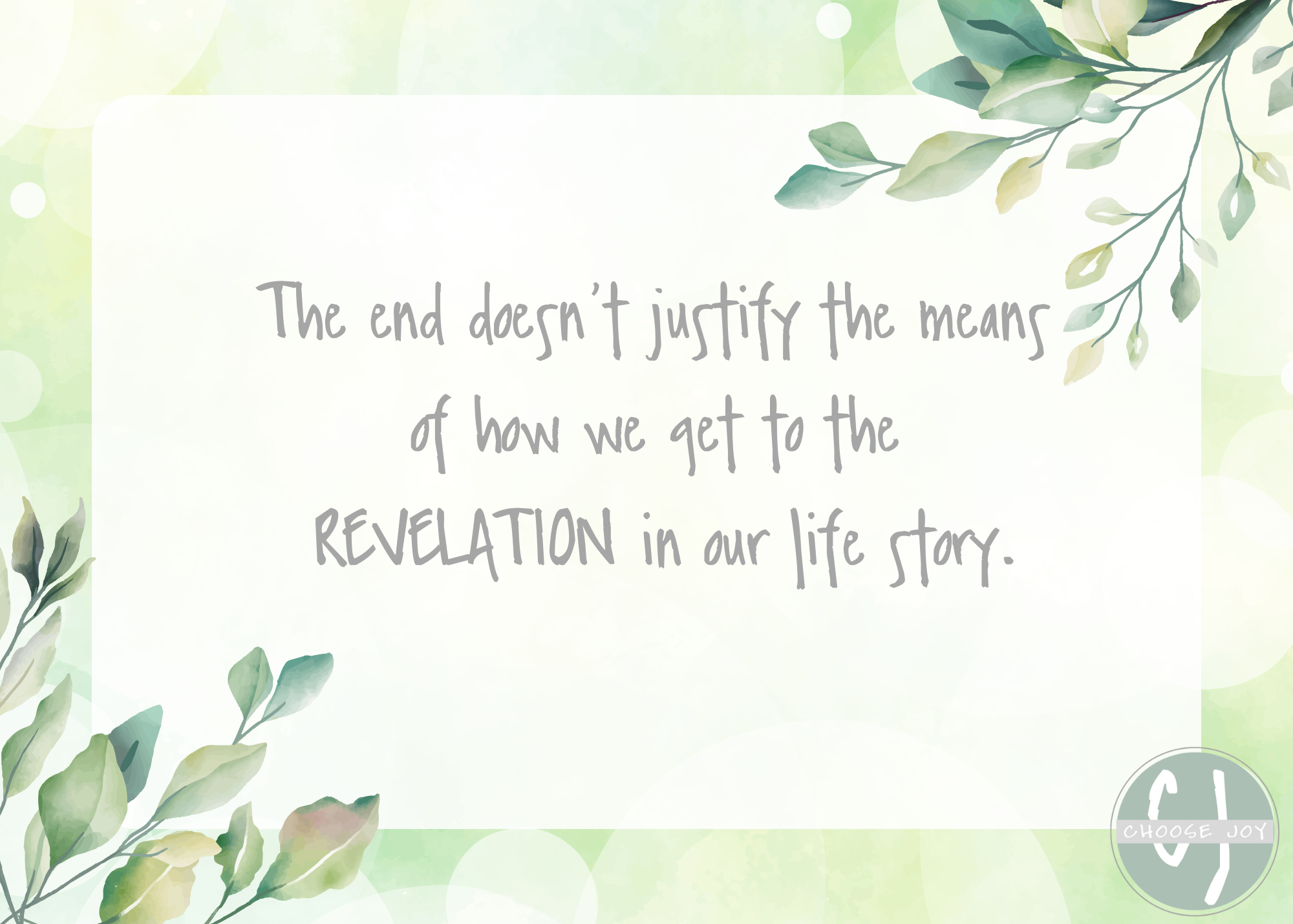
    The end doesn’t justify the means of how we get to the Revelation, in our life story.

    Our lives are part of a larger story – one that unfolds according to God’s plan. Our individual stories are woven into the grand narrative of God’s redemption. Our choices and actions contribute to the plot.

    Each of our life stories are unique, with its own struggles, triumphs, and relationships. To live it well, we must seek God’s guidance to understand our role in His story. His purpose for our lives.

    Reflect on your passions, talents, and experiences to discover how God is calling you to serve. Sit with Him in the quiet and let Him lead you.

    We should be intentional in making choices that align with God’s values, such as love, forgiveness, and compassion. God told us we will face troubles and challenges. Don’t shy away from them. Instead, use them as opportunities for growth, learning and dependence on Him.

    The ultimate revelation of your life story is eternal life with God. This promise gives your story purpose and hope.

    With love and joy,

    Laura

  • The Luck of the Irish: Finding Blessings Beyond the Blarney Stone

    As we celebrate St. Patrick’s Day, many of us will be donning green attire, searching for four-leaf clovers, and perhaps even kissing the Blarney Stone in hopes of securing a wee bit of good fortune. But as Christians, we know that our blessings come from a much higher source than a pot of gold at the end of a rainbow.

    While St. Patrick’s Day has become synonymous with all things Irish, it’s essential to remember the real story behind this beloved saint. Patrick, a humble Christian missionary, was instrumental in spreading the Gospel to the Emerald Isle. His unwavering faith and commitment to sharing God’s love with the Irish people had a profound impact on their lives and culture.

    As we reflect on the concept of “luck,” we’re reminded that our blessings come from God’s sovereign hand.

    Jeremiah 29:11, we’re told, “For I know the plans I have for you,” declares the Lord, “plans to prosper you and not to harm you, plans to give you hope and a future.”

    This promise reassures us that our lives are not governed by chance or fate, but by a loving God who desires to bless and prosper us.

    So, what does it mean to experience good fortune as a Christian? Is it merely a matter of chance or coincidence? Absolutely not!

    When we acknowledge God as the source of all blessings, we begin to see that every good thing in our lives is a direct result of His loving providence.

    In Deuteronomy 8:17-18, Moses cautions the Israelites against attributing their success to their own strength or abilities, reminding them that it is God who gives them the power to prosper. This same principle applies to our lives today. When we recognize God’s hand in our blessings, we’re compelled to give thanks and glory to Him, rather than relying on luck or our own efforts.

    As we celebrate St. Patrick’s Day, let’s not get caught up in the notion of relying on luck or chance for our blessings. Instead, let’s fix our eyes on the One who is the source of all good things. May we, like St. Patrick, be faithful in sharing God’s love with others and trusting in His sovereign providence to guide our lives.

    How can you, like St. Patrick, share God’s love with others and trust in His sovereign providence to guide your life?

    With love and joy,

    Laura