Category: Choices

  • Choose Again

    Choose Again

    How Do I Walk Through It With Him?

    There were days during cancer treatment when I would finally start feeling a little better. The sickness would begin to ease. I would have a little more energy. Food might taste a little better. For a brief moment, I would begin to feel somewhat like myself again.

    And then it was time to go back.

    I remember walking through the doors of the cancer center knowing what was waiting for me. Another treatment. And I also knew what would likely come afterward. Sick again. Tired again. Pain again. Each time, it may be even worse.

    I had just started feeling better—and I was walking through those doors knowing I was about to begin the cycle all over again. There wasn’t anything glamorous about faith in those moments.

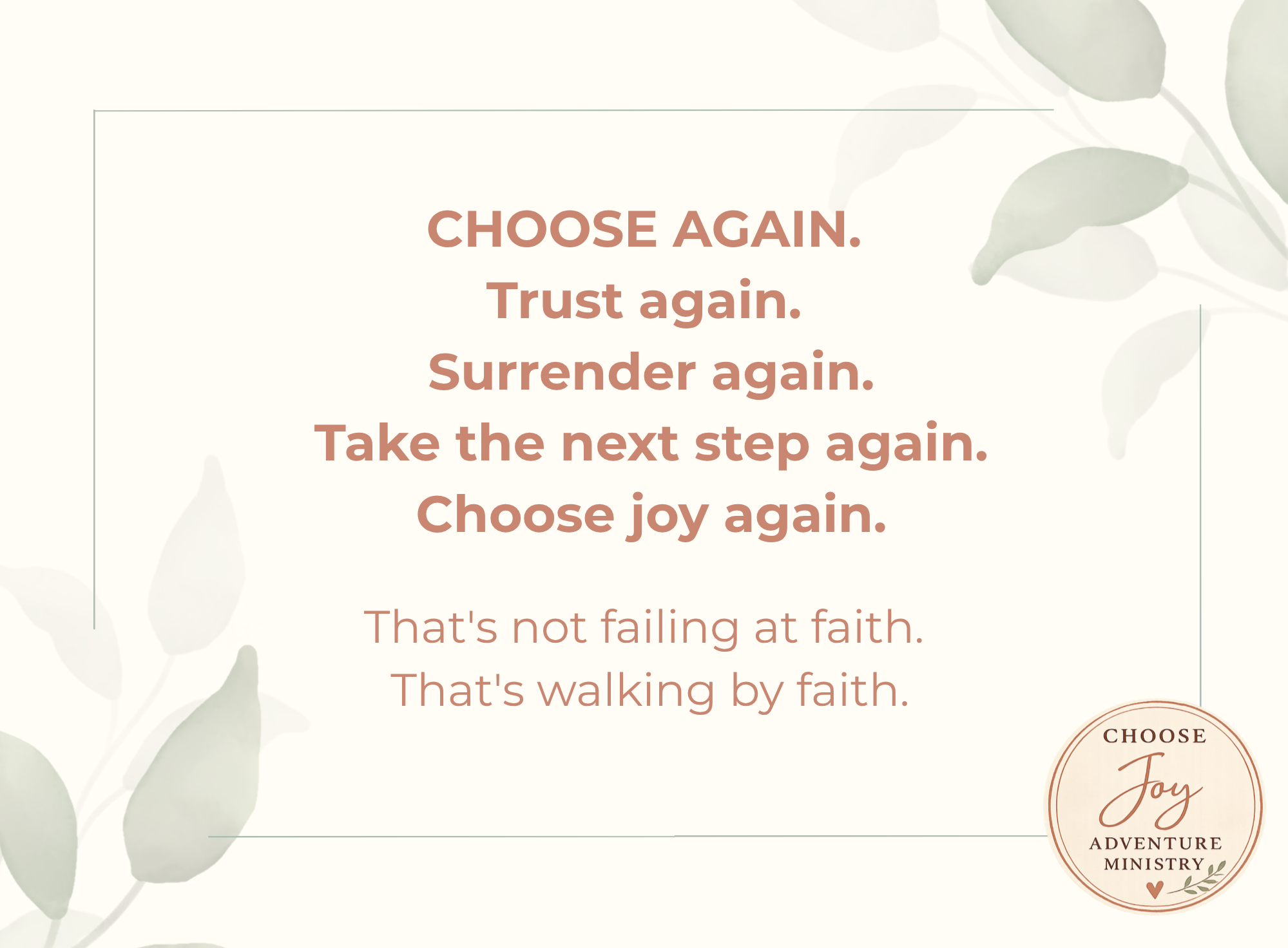
    I didn’t walk through those doors because I had conquered fear once and for all. I walked through them because it was the next step. And I had to choose again. Trust again. Surrender again. Take the next step again. Choose joy again.

    Looking back, I think those moments taught me something important about what it really means to walk through hard things with Jesus.

    Last week, we talked about Walk Through It With Him. You don’t get to choose everything you walk through. But you can choose Who you walk through it with. I believe that with my whole heart. But there’s another part we need to talk about.

    What happens when you wake up tomorrow and the hard thing is still hard?

    What happens when you surrendered it yesterday—but today you’re afraid again?

    What happens when you trusted God last week—but another test result, another disappointment, another unanswered prayer brings all the uncertainty rushing back?

    What happens when you thought you were doing better, and suddenly you aren’t?

    You choose again.

    I think sometimes we believe that if our faith were stronger, we wouldn’t have to keep doing this.

    I already gave this to God. Why am I worried again?

    I thought I trusted Him. Why am I afraid again?

    I thought I had worked through this grief. Why am I crying again?

    I chose joy yesterday. Why can’t I feel it today?

    Here’s something I wish we said more often: Having to trust God again doesn’t mean you didn’t trust Him the first time.

    Needing to surrender again doesn’t mean yesterday’s surrender wasn’t sincere. Sometimes today’s circumstances simply require today’s surrender. Today’s trust. Today’s grace. Today’s next step.

    Maybe that’s why Scripture tells us His mercies are “new every morning.” God already knew we would need Him again today.

    I wish I could give you five steps that, once completed, would make the hard thing easy.

    I can’t.

    That’s not how my life has worked. Instead, these are practices I’m learning to return to over and over again.

    1. STAY

    When life hurts, our instinct can be to pull away. Sometimes we’re disappointed with God. Sometimes we’re confused. Sometimes we don’t know what to pray anymore. Sometimes we’re simply tired.

    But walking through it with Him begins by staying. Stay close. Stay honest. Stay in His Word. Keep talking to Him—even when the conversation sounds more like questions than praise.

    I’ve learned that God doesn’t need a polished version of me. He already knows when I’m afraid. He already knows when I’m disappointed. He already knows the questions I haven’t said out loud.

    Staying doesn’t mean pretending. It means bringing the real me to the real Jesus.

    And sometimes tomorrow, I have to choose to stay again.

    2. TRUST

    Cancer taught me how little control I actually had.

    There were doctors, treatments, decisions, scans, and second opinions. I wanted information because information made me feel like maybe I could control what happened next. But eventually I had to confront something difficult: I could make wise decisions. I could ask questions. I could seek good medical care. I could do everything available to me. But I couldn’t guarantee the outcome.

    There comes a point where faith has to move from:

    “God, explain this to me.”

    to:

    “God, I don’t understand this, but I know You.”

    When I don’t know what God is doing, I’m learning to return to what I know about who God is. He is faithful. He is present. He loves me. He sees what I cannot see. Trust doesn’t mean I’m certain about the outcome.

    Trust means I’m learning to be certain about the One holding it.

    And yes, sometimes I have to choose that again tomorrow.

    3. OBEY

    Walking through something hard can make us want the whole map. How long will this last? What’s going to happen? When will things get better? How is this story going to end?

    I wanted answers too. But most of the time, God didn’t give me the whole map. There was simply a next step. Go to the appointment. Walk through the doors. Sit in the chair. Receive the treatment. Let someone help. Rest. Get up tomorrow. Do the next thing.

    I think spiritual obedience often looks like that too. We want God to show us the next ten steps. He often gives us one.

    So I’ve learned to ask:

    “Lord, what is my next faithful step?”

    I don’t need tomorrow’s strength today.

    I need enough grace to walk today’s step with Him.

    4. RELEASE

    This may be one of the hardest lessons I’ve learned. Letting go isn’t giving up.

    For a long time, surrender sounded passive to me—as though releasing something meant I had stopped caring.

    But surrender isn’t saying: “It doesn’t matter what happens.” It matters deeply.

    Surrender says:

    “God, I care very much about what happens. But I recognize that I cannot control the outcome, so I am giving what I cannot carry to You.”

    There’s a difference between giving up and giving over. Giving up says there is no hope.

    Giving over says: My hope isn’t in my ability to control this. My hope is in You.

    And sometimes I give something over to God at night…only to realize I’ve picked it back up by morning. So I release it again.

    That’s not failure.

    That’s surrender becoming a way of life.

    5. REMEMBER

    Hard seasons have a way of narrowing our vision. We can become so focused on what’s happening right now that we forget all the places God has already met us.

    During cancer, He often showed up through people. Meals. Prayers. Friends who sat beside me. People who walked with me when I didn’t have much strength of my own.

    Small reminders: You’re not alone.

    Remembering God’s faithfulness doesn’t mean believing, “Everything worked out exactly the way I wanted before, so it will again.” Life has taught me that isn’t always true.

    Remembering means: God was faithful there. His character hasn’t changed here.

    Sometimes when I can’t see what God is doing ahead of me, I need to turn around and remember where I’ve already seen Him behind me.

    And then I take another step.

    When I wrote Still Choosing Joy: Lessons of Faith Through Cancer, the title carried more meaning than I realized.

    Not: I Chose Joy. As though I made one brave decision and never struggled again.

    But: Still Choosing Joy. Choosing is ongoing.

    Still means after the diagnosis. After another treatment. After another difficult day. After the fear returns. After the prayer hasn’t been answered. After I thought I had surrendered—and realized I needed to surrender again.

    Still. Still trusting. Still walking. Still believing. Still choosing.

    And maybe that is what faithfulness looks like more often than we realize. Not one enormous, heroic act of faith. But a thousand small choices to keep walking with Jesus.

    Maybe you thought you had already dealt with this. Maybe you thought you’d moved past the grief. Maybe you believed you had finally surrendered that child, that marriage, that diagnosis, that dream, that unanswered prayer. And now it’s heavy again.

    Please hear this: You haven’t necessarily gone backward. You may simply be standing at another set of doors.

    I remember those cancer center doors. I knew what was on the other side. And I still had to walk through them. Maybe you have your own doors in front of you today. You don’t need enough faith for the entire journey. You only need to decide Who you’re going to walk through those doors with.

    Stay. Trust. Obey. Release. Remember.

    And when you need to…do it again.

    His mercy will be there again too.

    “Because of the Lord’s great love we are not consumed, for his compassions never fail. They are new every morning.”
    — Lamentations 3:22–23

    Maybe today your prayer is simply: Jesus, I’m tired of having to do this again. Tell Him. And then perhaps add: But I’m still here. Help me stay close. Help me trust You with what I don’t understand. Show me today’s faithful step. Help me release what I cannot control. Remind me where You have already been faithful. And give me grace to choose You again today.

    You don’t have to walk through it perfectly. You just have to keep walking with Him.

    Don’t just get through it. Walk through it with Him—again today.

    Still walking. Still trusting. Still choosing joy.

    With love and joy,

    Laura

  • Walk Through It With Him

    Walk Through It With Him

    When Faith Meets Real Life

    There are some things in life I would never have chosen. Divorce. Watching my sister Sara live with a disease that slowly took away so much of the life she once knew. Losing my dad. Cancer.

    I wouldn’t choose any of them. And I certainly wouldn’t tell you that I walked through them perfectly.

    I didn’t.

    There were tears. Questions. Fear. Disappointment. I prayed, believing God could change the circumstances—and there were times He didn’t answer the way I desperately wanted Him to.

    But looking back, I can see something I couldn’t always see while I was living it:

    God was forming me in the middle of it.

    We’ve been talking about walking with Jesus and letting our relationship with Him shape how we live. But formation sounds a little different when life gets hard, doesn’t it?

    It’s one thing to say, “God, I trust You,” when the path in front of us makes sense. It’s another thing to say it when the doctor says cancer. Or when a marriage ends. When someone you love is suffering, and you can’t fix it. When you stand beside a grave. When you’ve prayed the same prayer for months—or years—and Heaven seems quiet.

    That’s when what we say we believe begins to meet real life. And I think that’s where some of our deepest formation happens.

    Not because suffering itself is good. Not because God expects us to smile through heartbreak and pretend we’re okay. But because the hard places reveal where we’re placing our trust.

    When I was diagnosed with Stage 3 triple-negative breast cancer, life changed quickly.

    Suddenly there were decisions to make, treatments to endure, and questions I couldn’t answer. Six months of chemotherapy. The “Red Devil.” Losing my hair. Radiation. Appointments. Side effects. Uncertainty.

    And fear.

    I had spent years encouraging other people to Choose Joy. Now I had to decide what those words meant when I didn’t feel joyful. I had questions for God.

    Why is this happening?

    Why now?

    What is going to happen to me?

    God, where are You in this?

    I wish I could tell you I immediately responded with unwavering faith and never struggled. That wouldn’t be true. And maybe that’s important to say.

    Faith isn’t the absence of fear. Trust isn’t the absence of questions. And joy isn’t the absence of sorrow.

    I was learning all of that in real time.

    Somewhere along that journey, however, my question began to change. Instead of only asking: “God, why is this happening to me?” I began asking: “God, what do You want me to learn here? What do You want to do in me? And how can You use me even here?”

    My cancer hadn’t disappeared. The treatments hadn’t suddenly become easy. I still didn’t know exactly how the story would end. But something was changing. Me.

    There is a difference between believing God caused every painful thing that happens and believing God can meet us in every painful thing that happens. I don’t believe we have to call suffering good to believe God is good. We don’t have to pretend the valley is beautiful. We don’t have to be thankful for cancer, divorce, disease, death or disappointment.

    But we can trust that God will not waste the places we surrender to Him. He can meet us there. Teach us there. Strengthen us there. Reveal Himself to us there. And sometimes He uses those very places to help us see another person who is walking through something similar.

    I’ve learned that letting go isn’t the same as giving up.

    Sometimes letting go means releasing my demand to know how the story is going to turn out and placing the story back into God’s hands. That’s surrender. And surrender is part of formation.

    My sister Sara understood this in a way few people I’ve known ever have.

    Her physical world became smaller and smaller as disease took away so many things most of us take for granted. Yet this was how Sara described joy:

    “The unwavering trust that God knows what He is doing and blessed me with the opportunity to be part of it. Not despite what is happening in my life, but because of it. When everything earthly feels heavy, He gives me an internal lightness that can’t be touched.”

    Those words mean something different when you know what she was living through when she wrote them. Sara wasn’t pretending life wasn’t hard. She knew it was hard. She was learning to trust God inside the hard. And I think that’s an important distinction.

    Because somewhere along the way, we can begin to think choosing joy means putting a smile on our face and declaring everything is fine. It doesn’t.

    Joy isn’t pretending our circumstances are good. Joy is learning to trust the One who walks through them with us.

    Psalm 23:4 says:

    “Even though I walk through the darkest valley, I will fear no evil, for you are with me.”

    I’ve been thinking about the word through. David doesn’t say there won’t be a valley. He doesn’t say God immediately removes him from it. He walks through it.

    And the comfort isn’t found in understanding the valley. It’s found in these words:

    “You are with me.”

    Maybe that’s what discipleship looks like when faith meets real life. We seek Him there. We follow Him there. We abide in Him there. We choose joy there. And slowly, step after step, He forms us there.

    Maybe your hard thing isn’t cancer. Maybe you’re waiting for an answer. Maybe someone you love is hurting. Maybe life has changed, and you’re still trying to figure out what the new normal looks like. Maybe you’re grieving something other people don’t even know you’ve lost. Maybe you’re disappointed with God, and you’re afraid you’re not supposed to admit that. Maybe you’ve prayed and prayed—and nothing seems to be happening.

    I don’t have an easy answer for you.

    And I’m not going to tell you that if you just have enough faith, everything will work out exactly the way you hope. Life has taught me otherwise.

    But I can tell you this:

    You do not have to walk through it alone.

    The same God who met me in a chemotherapy chair was with me through divorce, grief, loss, and questions I couldn’t answer. And He’s still teaching me to walk with Him today.

    Not perfectly. Sometimes confidently. Sometimes with shaky knees. Sometimes with joy. Sometimes with tears. But still walking. Still trusting. Still choosing. Still being formed.

    As we continue this Walk With Me journey, we’re going to take discipleship into some very real places. We’re going to talk about suffering. Waiting. Disappointment. Uncertainty. Change. Unanswered prayer.

    We aren’t going to rush through them or cover them with Christian clichés. Instead, we’re going to ask:

    What does it look like to actually walk with Jesus here?

    Because you may not get to choose everything you walk through. But you can choose Who you walk through it with.

    So whatever you’re carrying today, you don’t have to have all the answers. You don’t have to pretend it doesn’t hurt. You don’t even have to know what the next ten steps look like. Take the next one. And don’t just get through it. Walk through it with Him.

    What are you walking through right now that you wish God would simply take away?

    Instead of only asking, “God, why?” try sitting with Him long enough to also ask:

    “Lord, what do You want to show me about Yourself here? What are You forming in me as I walk through this with You?”

    Then be still. You don’t need to manufacture an answer. Just stay with Him.

    Adventure awaits — will you Choose Joy?

    With love and joy,

    Laura

  • Walk WITH Him: Growth Begins by Staying Close

    Walk WITH Him: Growth Begins by Staying Close

    Walk With Me — It’s Time to Grow

    “Abide in me, and I in you. As the branch cannot bear fruit by itself, unless it abides in the vine, neither can you, unless you abide in me.” — John 15:4

    Last week, we began with an invitation:

    It’s time to grow.

    Not simply to know more about Jesus, but to allow what we believe about Jesus to increasingly become the way we live.

    But where does that kind of growth begin?

    Do we need to study more? Pray more? Serve more? Try harder? Become more disciplined?

    Those things can certainly be part of spiritual growth. But I don’t think they’re where it begins.

    Growth begins with relationship.

    Before we can walk LIKE Jesus, we have to learn to walk WITH Jesus.

    It’s possible to know a lot about someone without actually knowing them very well. And if we’ve been Christians for a while, I wonder if we can sometimes do the same thing with Jesus.

    We know the stories. We know the verses. We know the right answers.

    We may begin our morning reading Scripture and talking with God—and then close our Bible, get up from the chair, and spend the rest of the day operating as though everything depends on us.

    We make decisions. We solve problems. We respond to people. We carry our worries. We plan our futures.

    And somewhere along the way, Jesus can unintentionally become Someone we spent time with that morning rather than Someone we’re walking with throughout the day.

    But Jesus didn’t simply say, “Learn about Me.”

    He said, “Follow Me.”

    That’s an invitation to a life lived together.

    I love the idea of having a quiet time with Jesus in the morning. There is something precious about opening God’s Word before the noise of the day begins.

    But walking with Jesus can’t end when we close our Bible.

    What happens during the other twenty-three hours?

    What happens when the phone rings with news we weren’t expecting?

    When someone says something that hurts us?

    When we’re trying to make a decision and don’t know what to do?

    When the answer we’ve been praying for still hasn’t come?

    When we’re irritated, disappointed, afraid, tired, or overwhelmed?

    What happens when we’re folding laundry, driving to work, sitting in a waiting room, making dinner, answering emails, caring for someone we love, or lying awake at 2 a.m. with thoughts that won’t stop?

    That’s where discipleship becomes real.

    Walking with Jesus means learning to recognize that He is present in those moments too. And instead of immediately reacting, fixing, controlling, worrying, or relying on ourselves, we begin learning to turn toward Him.

    Jesus, You’re here. What does it look like to walk with You in this?

    Maybe that’s one of the simplest prayers of discipleship.

    I’ve been thinking about walking with Jesus in three simple movements:

    WITH Him → AWARE of Him → RESPONSIVE to Him

    First, we learn to live with Him.

    We stop dividing life into “God time” and “everything else.”

    Jesus comes with us into all of it. Then, as we walk with Him, we become increasingly aware of Him. We begin noticing what His Word says about the situation we’re facing. We become more aware of what is happening in our own hearts.

    Why did that comment bother me so much?

    Why am I trying so hard to control this?

    Why am I afraid?

    Am I responding from truth—or from fear?

    Am I trying to get my way—or am I willing to surrender?

    And as we become more aware, we learn to become responsive to Him. Sometimes responding means moving. Sometimes it means waiting. Sometimes it means speaking. Sometimes it means remaining quiet.

    It may mean forgiving when we’d rather hold onto the hurt. Apologizing when we’d rather defend ourselves. Trusting when we’d rather control. Serving when we’d rather be served. Obeying when our feelings are telling us to do something completely different.

    That is growth.

    Not perfection.

    Practice.

    We’ve talked about seeking Jesus. We’ve talked about following Him. We’ve talked about abiding in Him.

    But here’s what I’m realizing:

    We never graduate from those things.

    A new believer seeks Jesus—and a mature disciple still seeks Him.

    A new believer learns to follow Jesus—and a mature disciple still wakes up every morning needing to follow.

    A new believer learns to abide—and maturity may actually teach us just how desperately dependent upon Him we really are.

    Jesus gives us such a beautiful picture of this in John 15. A branch doesn’t produce fruit by deciding to work harder. It doesn’t grit its teeth and say, Today I’m going to be more fruitful. It remains connected to the vine.

    Jesus said:

    “Apart from me you can do nothing.” — John 15:5

    That’s humbling. But I also find it incredibly freeing. Because spiritual maturity isn’t Christian self-improvement.

    God isn’t asking us to transform ourselves into the image of Jesus through sheer determination. He’s inviting us to remain close enough to Jesus that He transforms us.

    Have you ever spent enough time with someone that you started picking up some of their mannerisms? Maybe you started using one of their phrases. Laughing at the same things. Responding in similar ways.

    There’s something about proximity that changes us. I think there’s a spiritual truth tucked inside that idea. The more time we spend walking with Jesus, the more His heart begins shaping ours.

    We begin seeing people differently. Our reactions begin changing. The things that once seemed incredibly important may start losing their grip.

    Compassion grows.

    Patience grows.

    Humility grows.

    Trust grows.

    We begin wanting what He wants. Not because we’ve mastered a list of Christian behaviors. But because we’ve been walking with Jesus.

    And slowly, sometimes so slowly we don’t even recognize it at first, He changes us.

    Maybe you’ve been thinking about spiritual growth and feeling overwhelmed. There is so much you don’t know. So much you still struggle with. So many places where you wish you were further along.

    Can I remind you of something?

    We’re not learning how to finish the journey. We’re learning how to faithfully take the next step. So don’t worry about ten steps from now.

    Bring Jesus into this one. The conversation you’re about to have. The decision you’re trying to make. The worry you’ve been carrying. The relationship that’s difficult. The prayer that hasn’t been answered. The ordinary responsibilities waiting for you today.

    Instead of asking only, “What should I do?”

    Maybe begin asking:

    “Jesus, how do I walk with You in this?”

    And then stay close enough to listen.

    This Walk With Me season isn’t about leaving behind everything we’ve already learned. We’re going deeper. We’re going to keep seeking. Keep following. Keep abiding. Keep choosing joy. Keep inviting others along.

    Because eventually, walking WITH Jesus changes the way we walk THROUGH life.

    And the more we walk with Him, the more we begin to walk LIKE Him.

    Eventually, someone else may see what Jesus has done in us and need us to turn toward them and say:

    “Walk with me.”

    But we’re not there yet.

    For today, let’s simply begin here:

    Walk WITH Him.

    Stay close.

    Notice His presence.

    Listen for His voice through His Word.

    Respond when He leads.

    And faithfully take the next step.

    Because maybe spiritual growth isn’t about trying harder to become like Jesus.

    Maybe it’s about staying close enough to Jesus that He changes us.

    A Question for the Journey

    As you move through your ordinary day, ask yourself: Am I simply believing in Jesus—or am I learning to live my everyday life WITH Jesus?

    Then choose one situation you’re facing today and pray: Jesus, You are here. Help me walk with You in this.

    One situation.

    One prayer.

    One faithful step.

    And tomorrow?

    We’ll walk with Him again.

    Adventure awaits — will you Choose Joy?

    With love and joy,

    Laura

  • Walk With Me: It’s Time to Grow

    Walk With Me: It’s Time to Grow

    “But solid food is for the mature, who by constant use have trained themselves to distinguish good from evil.” — Hebrews 5:14

    Let me ask you a question.

    Are you growing?

    Not—How long have you been a Christian?

    Not—How many Bible studies have you completed?

    Not—How many sermons have you listened to?

    Not even—How much Scripture do you know?

    But is what you know about Jesus changing the way you live with Jesus?

    That’s a different question.

    And it may be one of the most important questions we ask as we continue learning what it means to walk with Him. Hebrews 5:12–14 gives us an interesting—and somewhat uncomfortable—picture of spiritual maturity.

    The writer compares spiritual infancy to needing milk and spiritual maturity to being ready for solid food. His concern wasn’t simply that his readers needed to learn more. They had already been taught truth.

    They needed to grow in their ability to live it. And tucked into verse 14 is a phrase I don’t want us to miss:

    “trained by constant practice.”

    Those words tell us something important about spiritual growth. We aren’t transformed simply by accumulating Christian information.

    We are transformed as God’s truth moves from our heads, settles into our hearts and begins changing the way we live. We have to practice it.

    My sister Sara had a phrase that has stayed with me for years:

    “Change is inevitable. Growth is intentional.”

    Sara knew quite a bit about change.

    Her life changed in ways she never would have chosen. Illness eventually took away her ability to work, travel and even leave her home.

    Those changes happened to her. But what she did with them?That was something different.

    Sara once wrote a blog post about one of her life goals: to be intentional in all things. She believed that everything we do—even the smallest things—has an impact.

    A smile. A compliment. Stopping what we’re doing long enough to really listen. Paying attention to someone else’s need. Choosing the way we speak to ourselves when we wake up in the morning. Responding when we feel God tugging at our hearts.

    None of those things seem particularly dramatic. But they are the places where growth happens.

    Sara wrote:

    “The way for me to make sure I’m living intentionally is to first be sure I’m really present in the moment.”

    Present in the moment. Maybe that’s where intentional growth begins. By paying attention.

    Are We Paying Attention?

    Sara admitted that as her physical world became smaller, it would have been easy to let the world pass her by. Instead, she made another choice.

    She wrote:

    “But it’s my intention to be open to whatever God has in store for me.”

    And then she said something that has always struck me:

    “My biggest fear is that He has a purpose for me and if I’m not paying attention, I’ll miss it.”

    What if spiritual maturity requires us to pay attention?

    Pay attention to God. Pay attention to His Word. Pay attention to our thoughts. Pay attention to the person standing in front of us. Pay attention to the little opportunities to obey. Pay attention to that nudge to encourage someone, forgive someone, call someone, serve someone or simply stop long enough to listen.

    Maybe we sometimes miss opportunities to grow because we’re waiting for God to teach us something new while He’s giving us opportunities to practice what He’s already taught us.

    Think about some of the truths many of us already know.

    We know God is trustworthy. But then something happens that doesn’t make sense.

    Now we get to practice trust.

    We know Scripture tells us to forgive. Then someone hurts us.

    Now we get to practice forgiveness.

    We know we’re supposed to take our thoughts captive. Then fear starts telling us everything that could possibly go wrong.

    Now we get to practice replacing lies with truth.

    We know we’re supposed to love others. Then God puts someone difficult in our path.

    Now we get to practice love.

    We know we’re supposed to obey God. Then obedience requires something uncomfortable.

    Now we get to practice obedience.

    This is where truth moves from our heads into our lives.

    And I think this is exactly what Hebrews means by being “trained by constant practice.”

    Believe It. Think It. Do It. Live It.

    Throughout our Walk With Me journey, we’ve been talking about a simple progression:

    Believe Right.
    Begin with biblical truth. What does God say?

    Think Right.
    Allow that truth to shape the thoughts and desires of our hearts.

    Do Right.
    Choose obedience—even when our feelings haven’t caught up yet.

    Feel Right.
    As our hearts and minds are continually brought under God’s truth, we begin experiencing the contentment and peace that come from walking His way.

    Growth happens as truth travels through that process again and again.

    We believe.

    We think.

    We choose.

    We practice.

    And little by little, through the work of the Holy Spirit, we change.

    That’s discipleship. That’s maturity. That’s growth.

    Growth Isn’t Perfection…

    There’s one more thing Sara said in that post that I think we need to hear.

    After describing her desire to live intentionally, she admitted:

    “I drop the ball on it all the time… I mess up with the best of them. But my intention is to always keep trying.”

    I love that honesty.

    Because intentional growth is not perfection.

    It’s practice.

    You will get distracted. Practice coming back.

    You will respond poorly. Practice apologizing.

    You will believe the fearful thought for a while. Practice replacing it with truth.

    You will miss an opportunity to obey. Pay attention when the next opportunity comes.

    We aren’t earning God’s love by getting everything right.

    We’re walking with the One who already loves us, allowing Him to train us as we follow.

    And training requires repetition.

    Again.

    And again.

    And again.

    Constant practice.

    So maybe the question this week isn’t:

    What do I need to learn?

    Maybe it’s:

    What has God already taught me that I need to practice?

    Is it trust?

    Forgiveness?

    Gratitude?

    Patience?

    Generosity?

    Encouragement?

    Surrender?

    Taking your thoughts captive?

    Being fully present with the people God has placed in front of you?

    Taking that step of obedience you’ve been putting off?

    Don’t make a list of twenty things you need to change.

    Ask God for one.

    Lord, what truth have You already taught me that You want me to practice today?

    Then pay attention.

    Because the opportunity to practice may show up in a conversation you weren’t expecting. An interruption you didn’t want. A person who tests your patience. A thought that needs to be captured. A prompting that would be easier to ignore. Or a circumstance you desperately wish God would change.

    And perhaps right there—in that very ordinary moment—God is growing you.

    Sara was right.

    Change is inevitable. Growth is intentional.

    But Hebrews helps us take it one step further.

    Growth requires practice.

    Not just knowing truth. Not just agreeing with truth. Not just highlighting truth in our Bibles.

    Living it.

    And perhaps spiritual maturity isn’t always God giving us something new to learn. Sometimes it’s God giving us another opportunity to practice what He’s already taught us.

    So this week, let’s pay attention. Let’s listen. Let’s obey. Let’s practice.

    And when we drop the ball, let’s get back up and practice again.

    Because we’re not trying to arrive at perfection.

    We’re learning to walk with Jesus.

    And as we walk with Him, it’s time to grow.

    Change is inevitable. Growth is intentional. Practice is how intention becomes transformation.

    Walk with me.

    With love and joy,

    Laura

  • Walk With Me: It’s Time to Grow

    Walk With Me: It’s Time to Grow

    It’s time for what we believe to become how we live.

    Over the past several weeks, we’ve been on quite an adventure together.

    We’ve talked about what it means to seek Jesus, follow faithfully, abide deeply, experience joy, and invite others along.

    But I’ve been thinking about something.

    What happens after we say yes to the invitation?

    We walk.

    We walk with Jesus.

    And somewhere along the way, what we believe has to become how we live.

    It’s one thing to believe God is trustworthy when life is going well.

    It’s another thing to trust Him when you don’t know what tomorrow holds.

    It’s one thing to know the Bible tells us not to worry.

    It’s another thing when you wake up in the middle of the night and your mind immediately begins running through everything that could possibly go wrong.

    It’s one thing to believe in forgiveness.

    It’s another thing to forgive someone who has deeply hurt you.

    It’s one thing to say, “I surrender.”

    It’s another thing when God asks you to release something you desperately want to control.

    That’s where discipleship gets real.

    There comes a point in our walk with Jesus when knowing what we believe isn’t enough.

    We have to learn to live it.

    Hebrews describes spiritual maturity this way:

    “But solid food is for the mature, who by constant use have trained themselves to distinguish good from evil.”

    — Hebrews 5:14

    I keep coming back to those words:

    By constant use.

    Other translations say “constant practice.”

    I love that picture of spiritual maturity.

    Not perfection.

    Practice.

    Sometimes we think a mature Christian is someone who knows all the answers, never struggles with doubt, never worries, never gets discouraged, and certainly never takes a wrong turn.

    But that isn’t what I see in Scripture.

    I see people learning to trust God.

    Learning to recognize His voice.

    Learning to obey.

    Learning to wait.

    Learning to surrender.

    Learning to return to truth when their thoughts begin leading them somewhere else.

    In other words, I see people practicing.

    And maybe that’s encouraging for those of us who still get it wrong sometimes.

    Spiritual maturity doesn’t mean we stop needing Jesus.

    I think it means we increasingly realize how desperately we need Him.

    We learn to walk closer.

    During training I received for biblical counseling, I was introduced to a simple progression that has stayed with me:

    Believe Right.
    Think Right.
    Do Right.
    Feel Right.

    The idea wasn’t that we can simply command ourselves to feel differently.

    It was that our beliefs matter because what we believe influences how we think, how we respond, and ultimately where we learn to find contentment.

    As I’ve thought about that framework again, I see such a connection to discipleship.

    Maybe we could say it this way:

    Biblical Truth → Mind & Heart → Obedience → Contentment

    What do I believe?

    Our starting point is truth.

    Not what culture says.

    Not what our circumstances seem to be saying.

    Not even what our emotions tell us in a difficult moment.

    What does God say is true?

    Jesus prayed:

    “Sanctify them by the truth; your word is truth.”

    — John 17:17

    If I am going to walk with Jesus, I need to know the One I am following.

    I need His Word.

    I need truth.

    And I need to continually seek Him.

    What am I thinking?

    Knowing truth doesn’t automatically mean every thought that enters my mind agrees with it.

    Have you noticed that?

    I can believe God is trustworthy and still spend an afternoon worrying.

    I can believe God has a plan and still become frustrated when His plan doesn’t look like mine.

    I can believe my identity is found in Christ and still compare myself with someone else.

    That’s why Scripture tells us:

    “…be transformed by the renewing of your mind.”

    — Romans 12:2

    Part of walking with Jesus is learning to stop and ask:

    What am I telling myself right now?

    And then:

    Is it true?

    We bring our thoughts back under the authority of God’s truth.

    We don’t ignore our emotions. We bring them with us as we abide in Him.

    What will I do?

    Eventually, truth asks something of us.

    This is where follow becomes more than a word.

    If I believe God is trustworthy, will I trust Him with this?

    If I believe He has forgiven me, will I stop living as though my past defines me?

    If He asks me to forgive, will I obey even when forgiveness is difficult?

    If He asks me to move, will I move?

    If He asks me to stay, will I stay?

    Sometimes we wait for our feelings to change before we’re willing to obey.

    But what if obedience comes first?

    What if I can say:

    “Jesus, I don’t feel ready. I don’t understand everything. I may even be afraid. But I trust You enough to take the next step.”

    That’s following.

    That’s faith.

    That’s practice.

    And I believe that’s growth.

    Where will I rest?

    The final word in that counseling framework was feel.

    But as I’ve gotten older and walked with Jesus through more seasons of life, I think the word I would use today is contentment.

    Paul wrote:

    “I have learned in whatever situation I am to be content.”

    — Philippians 4:11

    Did you catch that?

    Learned.

    Contentment wasn’t automatic for Paul.

    He learned it.

    And perhaps that is part of what happens as we walk with Jesus.

    We learn that peace doesn’t require everything around us to be peaceful.

    We learn that joy doesn’t require everything around us to be joyful.

    We learn that trust doesn’t require knowing how the story ends.

    We learn to rest because we know Who is walking with us.

    And that’s where we begin to experience joy in a completely different way.

    We live surrounded by anxiety.

    What if something goes wrong?

    What if I can’t fix this?

    What if the diagnosis isn’t good?

    What if my child makes the wrong decision?

    What if I lose this opportunity?

    What if God doesn’t answer the way I want Him to?

    The list is endless.

    And walking with Jesus doesn’t mean those thoughts will never enter our minds.

    It means we’re learning what to do when they do.

    What is true?

    Where are my thoughts going?

    What is God asking me to do?

    Can I trust Him with what I cannot control?

    And then we practice.

    Again.

    And again.

    And again.

    Not perfectly.

    Constantly.

    That’s what I want us to understand as we begin this next part of our Choose Joy Adventure.

    We aren’t leaving behind everything we’ve been talking about.

    We never graduate from seeking Jesus.

    We never become too mature to follow.

    We never outgrow our need to abide.

    We don’t arrive at a place where joy is automatic.

    And we certainly never stop inviting others along.

    Instead, we grow deeper into all of them.

    We seek when we don’t know what to do.

    We follow when Jesus shows us the next step.

    We abide when we’re tempted to run ahead.

    We choose joy because our confidence rests in Him rather than our circumstances.

    And eventually, as we learn to walk faithfully with Jesus, we can reach out a hand to someone walking beside us and say:

    “Walk with me.”

    So this is where our next adventure begins.

    We’re going to talk about what it means to:

    Walk WITH Him.

    Grow AS we walk.

    Walk THROUGH the difficult places with Him.

    Walk LIKE Him.

    And eventually…

    Walk WITH others.

    Not because we’ve arrived.

    Not because we know everything.

    But because we’re learning to faithfully take the next step.

    So let me leave you with a question:

    Is there a truth you already believe but aren’t consistently living?

    Don’t let that question lead you toward condemnation.

    Let it lead you toward Jesus.

    Maybe that’s exactly the place where He’s inviting you to grow.

    Maybe He’s simply saying:

    “Walk with Me. Let’s practice this together.”

    You don’t have to know everything to walk with Jesus.

    You simply have to be willing to take the next faithful step.

    It’s time to grow.

    It’s time for what we believe to become how we live.

    Let’s walk together.

    Adventure awaits — will you Choose Joy?

    With love and joy,

    Laura