Category: book

  • Choose Again

    Choose Again

    How Do I Walk Through It With Him?

    There were days during cancer treatment when I would finally start feeling a little better. The sickness would begin to ease. I would have a little more energy. Food might taste a little better. For a brief moment, I would begin to feel somewhat like myself again.

    And then it was time to go back.

    I remember walking through the doors of the cancer center knowing what was waiting for me. Another treatment. And I also knew what would likely come afterward. Sick again. Tired again. Pain again. Each time, it may be even worse.

    I had just started feeling better—and I was walking through those doors knowing I was about to begin the cycle all over again. There wasn’t anything glamorous about faith in those moments.

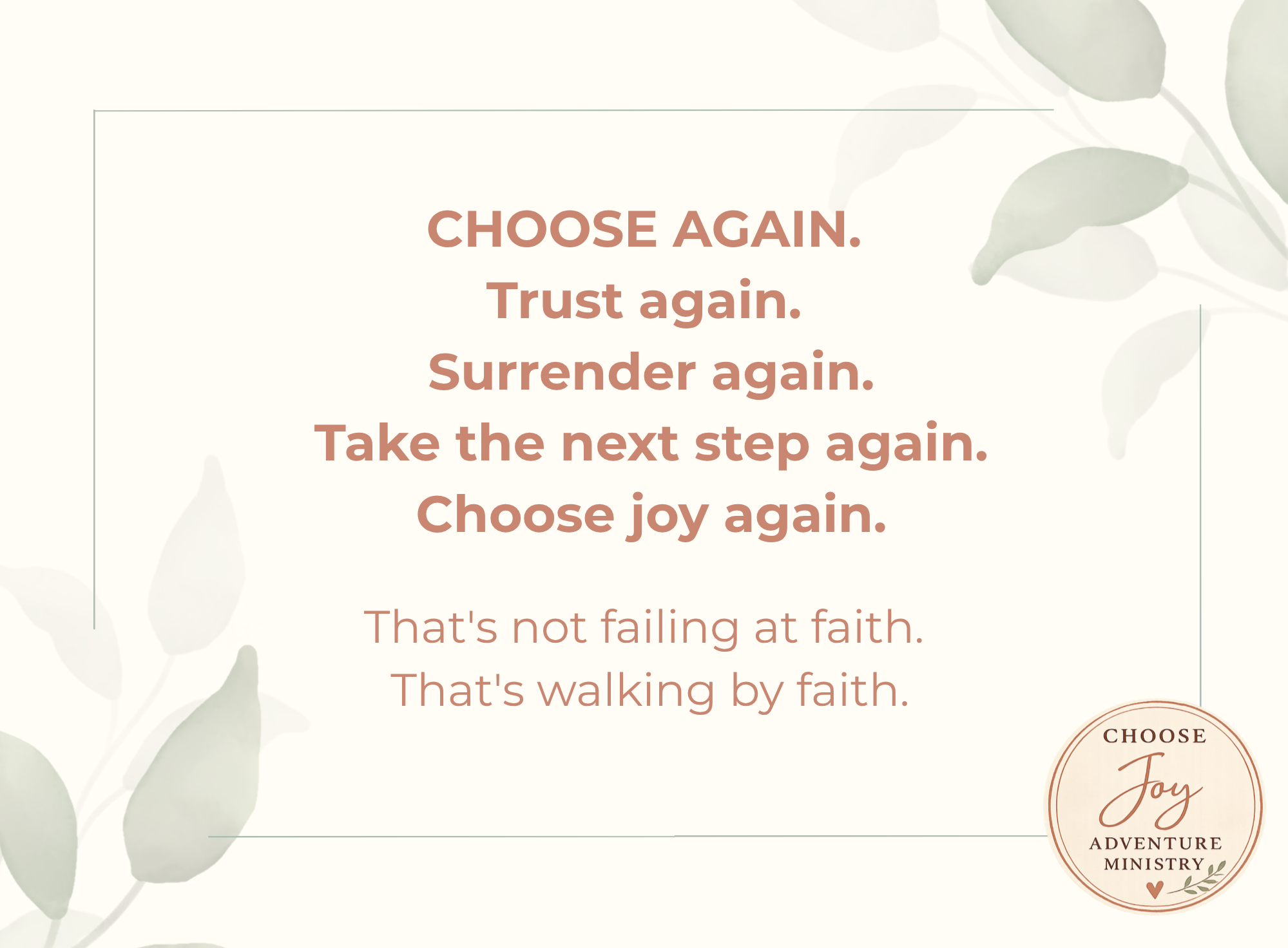
    I didn’t walk through those doors because I had conquered fear once and for all. I walked through them because it was the next step. And I had to choose again. Trust again. Surrender again. Take the next step again. Choose joy again.

    Looking back, I think those moments taught me something important about what it really means to walk through hard things with Jesus.

    Last week, we talked about Walk Through It With Him. You don’t get to choose everything you walk through. But you can choose Who you walk through it with. I believe that with my whole heart. But there’s another part we need to talk about.

    What happens when you wake up tomorrow and the hard thing is still hard?

    What happens when you surrendered it yesterday—but today you’re afraid again?

    What happens when you trusted God last week—but another test result, another disappointment, another unanswered prayer brings all the uncertainty rushing back?

    What happens when you thought you were doing better, and suddenly you aren’t?

    You choose again.

    I think sometimes we believe that if our faith were stronger, we wouldn’t have to keep doing this.

    I already gave this to God. Why am I worried again?

    I thought I trusted Him. Why am I afraid again?

    I thought I had worked through this grief. Why am I crying again?

    I chose joy yesterday. Why can’t I feel it today?

    Here’s something I wish we said more often: Having to trust God again doesn’t mean you didn’t trust Him the first time.

    Needing to surrender again doesn’t mean yesterday’s surrender wasn’t sincere. Sometimes today’s circumstances simply require today’s surrender. Today’s trust. Today’s grace. Today’s next step.

    Maybe that’s why Scripture tells us His mercies are “new every morning.” God already knew we would need Him again today.

    I wish I could give you five steps that, once completed, would make the hard thing easy.

    I can’t.

    That’s not how my life has worked. Instead, these are practices I’m learning to return to over and over again.

    1. STAY

    When life hurts, our instinct can be to pull away. Sometimes we’re disappointed with God. Sometimes we’re confused. Sometimes we don’t know what to pray anymore. Sometimes we’re simply tired.

    But walking through it with Him begins by staying. Stay close. Stay honest. Stay in His Word. Keep talking to Him—even when the conversation sounds more like questions than praise.

    I’ve learned that God doesn’t need a polished version of me. He already knows when I’m afraid. He already knows when I’m disappointed. He already knows the questions I haven’t said out loud.

    Staying doesn’t mean pretending. It means bringing the real me to the real Jesus.

    And sometimes tomorrow, I have to choose to stay again.

    2. TRUST

    Cancer taught me how little control I actually had.

    There were doctors, treatments, decisions, scans, and second opinions. I wanted information because information made me feel like maybe I could control what happened next. But eventually I had to confront something difficult: I could make wise decisions. I could ask questions. I could seek good medical care. I could do everything available to me. But I couldn’t guarantee the outcome.

    There comes a point where faith has to move from:

    “God, explain this to me.”

    to:

    “God, I don’t understand this, but I know You.”

    When I don’t know what God is doing, I’m learning to return to what I know about who God is. He is faithful. He is present. He loves me. He sees what I cannot see. Trust doesn’t mean I’m certain about the outcome.

    Trust means I’m learning to be certain about the One holding it.

    And yes, sometimes I have to choose that again tomorrow.

    3. OBEY

    Walking through something hard can make us want the whole map. How long will this last? What’s going to happen? When will things get better? How is this story going to end?

    I wanted answers too. But most of the time, God didn’t give me the whole map. There was simply a next step. Go to the appointment. Walk through the doors. Sit in the chair. Receive the treatment. Let someone help. Rest. Get up tomorrow. Do the next thing.

    I think spiritual obedience often looks like that too. We want God to show us the next ten steps. He often gives us one.

    So I’ve learned to ask:

    “Lord, what is my next faithful step?”

    I don’t need tomorrow’s strength today.

    I need enough grace to walk today’s step with Him.

    4. RELEASE

    This may be one of the hardest lessons I’ve learned. Letting go isn’t giving up.

    For a long time, surrender sounded passive to me—as though releasing something meant I had stopped caring.

    But surrender isn’t saying: “It doesn’t matter what happens.” It matters deeply.

    Surrender says:

    “God, I care very much about what happens. But I recognize that I cannot control the outcome, so I am giving what I cannot carry to You.”

    There’s a difference between giving up and giving over. Giving up says there is no hope.

    Giving over says: My hope isn’t in my ability to control this. My hope is in You.

    And sometimes I give something over to God at night…only to realize I’ve picked it back up by morning. So I release it again.

    That’s not failure.

    That’s surrender becoming a way of life.

    5. REMEMBER

    Hard seasons have a way of narrowing our vision. We can become so focused on what’s happening right now that we forget all the places God has already met us.

    During cancer, He often showed up through people. Meals. Prayers. Friends who sat beside me. People who walked with me when I didn’t have much strength of my own.

    Small reminders: You’re not alone.

    Remembering God’s faithfulness doesn’t mean believing, “Everything worked out exactly the way I wanted before, so it will again.” Life has taught me that isn’t always true.

    Remembering means: God was faithful there. His character hasn’t changed here.

    Sometimes when I can’t see what God is doing ahead of me, I need to turn around and remember where I’ve already seen Him behind me.

    And then I take another step.

    When I wrote Still Choosing Joy: Lessons of Faith Through Cancer, the title carried more meaning than I realized.

    Not: I Chose Joy. As though I made one brave decision and never struggled again.

    But: Still Choosing Joy. Choosing is ongoing.

    Still means after the diagnosis. After another treatment. After another difficult day. After the fear returns. After the prayer hasn’t been answered. After I thought I had surrendered—and realized I needed to surrender again.

    Still. Still trusting. Still walking. Still believing. Still choosing.

    And maybe that is what faithfulness looks like more often than we realize. Not one enormous, heroic act of faith. But a thousand small choices to keep walking with Jesus.

    Maybe you thought you had already dealt with this. Maybe you thought you’d moved past the grief. Maybe you believed you had finally surrendered that child, that marriage, that diagnosis, that dream, that unanswered prayer. And now it’s heavy again.

    Please hear this: You haven’t necessarily gone backward. You may simply be standing at another set of doors.

    I remember those cancer center doors. I knew what was on the other side. And I still had to walk through them. Maybe you have your own doors in front of you today. You don’t need enough faith for the entire journey. You only need to decide Who you’re going to walk through those doors with.

    Stay. Trust. Obey. Release. Remember.

    And when you need to…do it again.

    His mercy will be there again too.

    “Because of the Lord’s great love we are not consumed, for his compassions never fail. They are new every morning.”
    — Lamentations 3:22–23

    Maybe today your prayer is simply: Jesus, I’m tired of having to do this again. Tell Him. And then perhaps add: But I’m still here. Help me stay close. Help me trust You with what I don’t understand. Show me today’s faithful step. Help me release what I cannot control. Remind me where You have already been faithful. And give me grace to choose You again today.

    You don’t have to walk through it perfectly. You just have to keep walking with Him.

    Don’t just get through it. Walk through it with Him—again today.

    Still walking. Still trusting. Still choosing joy.

    With love and joy,

    Laura

  • Walk Through It With Him

    Walk Through It With Him

    When Faith Meets Real Life

    There are some things in life I would never have chosen. Divorce. Watching my sister Sara live with a disease that slowly took away so much of the life she once knew. Losing my dad. Cancer.

    I wouldn’t choose any of them. And I certainly wouldn’t tell you that I walked through them perfectly.

    I didn’t.

    There were tears. Questions. Fear. Disappointment. I prayed, believing God could change the circumstances—and there were times He didn’t answer the way I desperately wanted Him to.

    But looking back, I can see something I couldn’t always see while I was living it:

    God was forming me in the middle of it.

    We’ve been talking about walking with Jesus and letting our relationship with Him shape how we live. But formation sounds a little different when life gets hard, doesn’t it?

    It’s one thing to say, “God, I trust You,” when the path in front of us makes sense. It’s another thing to say it when the doctor says cancer. Or when a marriage ends. When someone you love is suffering, and you can’t fix it. When you stand beside a grave. When you’ve prayed the same prayer for months—or years—and Heaven seems quiet.

    That’s when what we say we believe begins to meet real life. And I think that’s where some of our deepest formation happens.

    Not because suffering itself is good. Not because God expects us to smile through heartbreak and pretend we’re okay. But because the hard places reveal where we’re placing our trust.

    When I was diagnosed with Stage 3 triple-negative breast cancer, life changed quickly.

    Suddenly there were decisions to make, treatments to endure, and questions I couldn’t answer. Six months of chemotherapy. The “Red Devil.” Losing my hair. Radiation. Appointments. Side effects. Uncertainty.

    And fear.

    I had spent years encouraging other people to Choose Joy. Now I had to decide what those words meant when I didn’t feel joyful. I had questions for God.

    Why is this happening?

    Why now?

    What is going to happen to me?

    God, where are You in this?

    I wish I could tell you I immediately responded with unwavering faith and never struggled. That wouldn’t be true. And maybe that’s important to say.

    Faith isn’t the absence of fear. Trust isn’t the absence of questions. And joy isn’t the absence of sorrow.

    I was learning all of that in real time.

    Somewhere along that journey, however, my question began to change. Instead of only asking: “God, why is this happening to me?” I began asking: “God, what do You want me to learn here? What do You want to do in me? And how can You use me even here?”

    My cancer hadn’t disappeared. The treatments hadn’t suddenly become easy. I still didn’t know exactly how the story would end. But something was changing. Me.

    There is a difference between believing God caused every painful thing that happens and believing God can meet us in every painful thing that happens. I don’t believe we have to call suffering good to believe God is good. We don’t have to pretend the valley is beautiful. We don’t have to be thankful for cancer, divorce, disease, death or disappointment.

    But we can trust that God will not waste the places we surrender to Him. He can meet us there. Teach us there. Strengthen us there. Reveal Himself to us there. And sometimes He uses those very places to help us see another person who is walking through something similar.

    I’ve learned that letting go isn’t the same as giving up.

    Sometimes letting go means releasing my demand to know how the story is going to turn out and placing the story back into God’s hands. That’s surrender. And surrender is part of formation.

    My sister Sara understood this in a way few people I’ve known ever have.

    Her physical world became smaller and smaller as disease took away so many things most of us take for granted. Yet this was how Sara described joy:

    “The unwavering trust that God knows what He is doing and blessed me with the opportunity to be part of it. Not despite what is happening in my life, but because of it. When everything earthly feels heavy, He gives me an internal lightness that can’t be touched.”

    Those words mean something different when you know what she was living through when she wrote them. Sara wasn’t pretending life wasn’t hard. She knew it was hard. She was learning to trust God inside the hard. And I think that’s an important distinction.

    Because somewhere along the way, we can begin to think choosing joy means putting a smile on our face and declaring everything is fine. It doesn’t.

    Joy isn’t pretending our circumstances are good. Joy is learning to trust the One who walks through them with us.

    Psalm 23:4 says:

    “Even though I walk through the darkest valley, I will fear no evil, for you are with me.”

    I’ve been thinking about the word through. David doesn’t say there won’t be a valley. He doesn’t say God immediately removes him from it. He walks through it.

    And the comfort isn’t found in understanding the valley. It’s found in these words:

    “You are with me.”

    Maybe that’s what discipleship looks like when faith meets real life. We seek Him there. We follow Him there. We abide in Him there. We choose joy there. And slowly, step after step, He forms us there.

    Maybe your hard thing isn’t cancer. Maybe you’re waiting for an answer. Maybe someone you love is hurting. Maybe life has changed, and you’re still trying to figure out what the new normal looks like. Maybe you’re grieving something other people don’t even know you’ve lost. Maybe you’re disappointed with God, and you’re afraid you’re not supposed to admit that. Maybe you’ve prayed and prayed—and nothing seems to be happening.

    I don’t have an easy answer for you.

    And I’m not going to tell you that if you just have enough faith, everything will work out exactly the way you hope. Life has taught me otherwise.

    But I can tell you this:

    You do not have to walk through it alone.

    The same God who met me in a chemotherapy chair was with me through divorce, grief, loss, and questions I couldn’t answer. And He’s still teaching me to walk with Him today.

    Not perfectly. Sometimes confidently. Sometimes with shaky knees. Sometimes with joy. Sometimes with tears. But still walking. Still trusting. Still choosing. Still being formed.

    As we continue this Walk With Me journey, we’re going to take discipleship into some very real places. We’re going to talk about suffering. Waiting. Disappointment. Uncertainty. Change. Unanswered prayer.

    We aren’t going to rush through them or cover them with Christian clichés. Instead, we’re going to ask:

    What does it look like to actually walk with Jesus here?

    Because you may not get to choose everything you walk through. But you can choose Who you walk through it with.

    So whatever you’re carrying today, you don’t have to have all the answers. You don’t have to pretend it doesn’t hurt. You don’t even have to know what the next ten steps look like. Take the next one. And don’t just get through it. Walk through it with Him.

    What are you walking through right now that you wish God would simply take away?

    Instead of only asking, “God, why?” try sitting with Him long enough to also ask:

    “Lord, what do You want to show me about Yourself here? What are You forming in me as I walk through this with You?”

    Then be still. You don’t need to manufacture an answer. Just stay with Him.

    Adventure awaits — will you Choose Joy?

    With love and joy,

    Laura

  • Walk With Me: It’s Time to Grow

    Walk With Me: It’s Time to Grow

    “But solid food is for the mature, who by constant use have trained themselves to distinguish good from evil.” — Hebrews 5:14

    Let me ask you a question.

    Are you growing?

    Not—How long have you been a Christian?

    Not—How many Bible studies have you completed?

    Not—How many sermons have you listened to?

    Not even—How much Scripture do you know?

    But is what you know about Jesus changing the way you live with Jesus?

    That’s a different question.

    And it may be one of the most important questions we ask as we continue learning what it means to walk with Him. Hebrews 5:12–14 gives us an interesting—and somewhat uncomfortable—picture of spiritual maturity.

    The writer compares spiritual infancy to needing milk and spiritual maturity to being ready for solid food. His concern wasn’t simply that his readers needed to learn more. They had already been taught truth.

    They needed to grow in their ability to live it. And tucked into verse 14 is a phrase I don’t want us to miss:

    “trained by constant practice.”

    Those words tell us something important about spiritual growth. We aren’t transformed simply by accumulating Christian information.

    We are transformed as God’s truth moves from our heads, settles into our hearts and begins changing the way we live. We have to practice it.

    My sister Sara had a phrase that has stayed with me for years:

    “Change is inevitable. Growth is intentional.”

    Sara knew quite a bit about change.

    Her life changed in ways she never would have chosen. Illness eventually took away her ability to work, travel and even leave her home.

    Those changes happened to her. But what she did with them?That was something different.

    Sara once wrote a blog post about one of her life goals: to be intentional in all things. She believed that everything we do—even the smallest things—has an impact.

    A smile. A compliment. Stopping what we’re doing long enough to really listen. Paying attention to someone else’s need. Choosing the way we speak to ourselves when we wake up in the morning. Responding when we feel God tugging at our hearts.

    None of those things seem particularly dramatic. But they are the places where growth happens.

    Sara wrote:

    “The way for me to make sure I’m living intentionally is to first be sure I’m really present in the moment.”

    Present in the moment. Maybe that’s where intentional growth begins. By paying attention.

    Are We Paying Attention?

    Sara admitted that as her physical world became smaller, it would have been easy to let the world pass her by. Instead, she made another choice.

    She wrote:

    “But it’s my intention to be open to whatever God has in store for me.”

    And then she said something that has always struck me:

    “My biggest fear is that He has a purpose for me and if I’m not paying attention, I’ll miss it.”

    What if spiritual maturity requires us to pay attention?

    Pay attention to God. Pay attention to His Word. Pay attention to our thoughts. Pay attention to the person standing in front of us. Pay attention to the little opportunities to obey. Pay attention to that nudge to encourage someone, forgive someone, call someone, serve someone or simply stop long enough to listen.

    Maybe we sometimes miss opportunities to grow because we’re waiting for God to teach us something new while He’s giving us opportunities to practice what He’s already taught us.

    Think about some of the truths many of us already know.

    We know God is trustworthy. But then something happens that doesn’t make sense.

    Now we get to practice trust.

    We know Scripture tells us to forgive. Then someone hurts us.

    Now we get to practice forgiveness.

    We know we’re supposed to take our thoughts captive. Then fear starts telling us everything that could possibly go wrong.

    Now we get to practice replacing lies with truth.

    We know we’re supposed to love others. Then God puts someone difficult in our path.

    Now we get to practice love.

    We know we’re supposed to obey God. Then obedience requires something uncomfortable.

    Now we get to practice obedience.

    This is where truth moves from our heads into our lives.

    And I think this is exactly what Hebrews means by being “trained by constant practice.”

    Believe It. Think It. Do It. Live It.

    Throughout our Walk With Me journey, we’ve been talking about a simple progression:

    Believe Right.
    Begin with biblical truth. What does God say?

    Think Right.
    Allow that truth to shape the thoughts and desires of our hearts.

    Do Right.
    Choose obedience—even when our feelings haven’t caught up yet.

    Feel Right.
    As our hearts and minds are continually brought under God’s truth, we begin experiencing the contentment and peace that come from walking His way.

    Growth happens as truth travels through that process again and again.

    We believe.

    We think.

    We choose.

    We practice.

    And little by little, through the work of the Holy Spirit, we change.

    That’s discipleship. That’s maturity. That’s growth.

    Growth Isn’t Perfection…

    There’s one more thing Sara said in that post that I think we need to hear.

    After describing her desire to live intentionally, she admitted:

    “I drop the ball on it all the time… I mess up with the best of them. But my intention is to always keep trying.”

    I love that honesty.

    Because intentional growth is not perfection.

    It’s practice.

    You will get distracted. Practice coming back.

    You will respond poorly. Practice apologizing.

    You will believe the fearful thought for a while. Practice replacing it with truth.

    You will miss an opportunity to obey. Pay attention when the next opportunity comes.

    We aren’t earning God’s love by getting everything right.

    We’re walking with the One who already loves us, allowing Him to train us as we follow.

    And training requires repetition.

    Again.

    And again.

    And again.

    Constant practice.

    So maybe the question this week isn’t:

    What do I need to learn?

    Maybe it’s:

    What has God already taught me that I need to practice?

    Is it trust?

    Forgiveness?

    Gratitude?

    Patience?

    Generosity?

    Encouragement?

    Surrender?

    Taking your thoughts captive?

    Being fully present with the people God has placed in front of you?

    Taking that step of obedience you’ve been putting off?

    Don’t make a list of twenty things you need to change.

    Ask God for one.

    Lord, what truth have You already taught me that You want me to practice today?

    Then pay attention.

    Because the opportunity to practice may show up in a conversation you weren’t expecting. An interruption you didn’t want. A person who tests your patience. A thought that needs to be captured. A prompting that would be easier to ignore. Or a circumstance you desperately wish God would change.

    And perhaps right there—in that very ordinary moment—God is growing you.

    Sara was right.

    Change is inevitable. Growth is intentional.

    But Hebrews helps us take it one step further.

    Growth requires practice.

    Not just knowing truth. Not just agreeing with truth. Not just highlighting truth in our Bibles.

    Living it.

    And perhaps spiritual maturity isn’t always God giving us something new to learn. Sometimes it’s God giving us another opportunity to practice what He’s already taught us.

    So this week, let’s pay attention. Let’s listen. Let’s obey. Let’s practice.

    And when we drop the ball, let’s get back up and practice again.

    Because we’re not trying to arrive at perfection.

    We’re learning to walk with Jesus.

    And as we walk with Him, it’s time to grow.

    Change is inevitable. Growth is intentional. Practice is how intention becomes transformation.

    Walk with me.

    With love and joy,

    Laura

  • I Choose to Encourage: The Power of Words

    “In the beginning was the Word, and the Word was with God, and the Word was God.” — John 1:1 (NIV)

    Words are powerful.

    With a few carefully chosen words, we can inspire someone to keep going, mend a broken relationship, or offer hope in a difficult season. Yet words can also wound, discourage, and leave scars that last for years.

    Think about the words that have impacted your life. Perhaps someone spoke encouragement over you when you doubted yourself. Maybe a teacher, mentor, friend, or family member saw something in you that you could not yet see in yourself. Their words helped shape who you became.

    Unfortunately, many of us can also recall hurtful words that have lingered long after they were spoken. Words have a way of embedding themselves in our hearts and influencing how we see ourselves and the world around us.

    That is why John 1:1 is so profound:

    “In the beginning was the Word, and the Word was with God, and the Word was God.”

    John identifies Jesus as the Word. Before creation, before time itself, the Word existed. Through Him, God brought life, order, and purpose into the world.

    God chose words to create.

    Throughout Scripture, we see the power of God’s spoken Word. He spoke light into darkness. He spoke truth into confusion. He spoke life where there was nothing.

    If words matter so much to God, they should matter to us.

    As followers of Christ, we have an opportunity every day to reflect His character through the words we speak. Our conversations can bring healing instead of hurt. Our comments can build confidence instead of tearing people down. Our encouragement can help others see what God is doing in their lives.

    Encouragement is more than simply saying something nice. It is intentionally speaking truth, hope, and life into someone else’s journey. Encouragement reminds people that they are seen, valued, and loved by God.

    The world offers plenty of criticism, negativity, and division. Social media feeds, news headlines, and daily conversations can quickly become places where people feel attacked rather than uplifted.

    What if Christians became known for encouragement?

    What if our words reflected the heart of Christ?

    What if we paused before speaking and asked ourselves, “Will these words build up or tear down?”

    Every day presents opportunities to encourage:

    • Thank someone for their faithfulness.
    • Speak hope to someone who is struggling.
    • Send a text of appreciation.
    • Pray with a friend.
    • Remind someone of God’s promises.

    Small words can have a lasting impact.

    Today, choose to encourage.

    Let your words reflect the One who is called the Word. Let them bring light into someone’s darkness and hope into someone’s uncertainty.

    Because words are never neutral. They shape how we see ourselves, others, and God. They can unite or divide, heal or harm, inspire or discourage.

    May we use our words wisely and intentionally, choosing encouragement wherever we go.

    Reflection Questions

    1. Who has encouraged you with their words recently?
    2. Is there someone in your life who needs encouragement today?
    3. How can your words better reflect the love and truth of Christ?

    Sometimes the simplest choice—choosing words that give life—can make the biggest difference.

    With love and joy,

    Laura

    This reflection connects with Day 13: “I Choose to Encourage” from the Today I Choose devotional. Each day offers practical encouragement and biblical truth to help you make intentional choices that strengthen your faith and impact those around you.

  • Irrevocable: Living in the Confidence of God’s Calling

    “For the gifts and the calling of God are irrevocable.” — Romans 11:29 (NASB)

    Have you ever questioned whether God could still use you after a failure, disappointment, or detour in life? Perhaps you’ve wondered if you missed your opportunity to fulfill God’s purpose. Maybe you’ve looked at your circumstances and thought, “Surely God has moved on to someone else.”

    Romans 11:29 offers a powerful reminder:

    “For the gifts and the calling of God are irrevocable.”

    The word irrevocable means something that cannot be taken back, withdrawn, canceled, or reversed. When God gives a gift or places a calling on a person’s life, He does not change His mind. His purposes are not based on our perfection but on His faithfulness.

    That should bring great comfort to every believer.

    God’s Gifts Are Given with Purpose.

    God has uniquely gifted each of us. Some gifts are obvious, while others develop over time. We may be gifted to encourage, teach, serve, lead, create, give, or show mercy. These gifts are not accidents; they are intentional expressions of God’s grace in our lives.

    Too often, we compare our gifts to someone else’s and conclude ours are less valuable. Yet God never intended for us to all serve in the same way. Just as every piece of a puzzle has a unique place, every believer has a unique purpose within the body of Christ.

    The gifts God has given you are not random talents. They are tools designed to glorify Him and bless others.

    Life doesn’t always unfold as we expected. We make mistakes. We take wrong turns. We experience loss, hardship, and seasons of uncertainty.

    Yet God’s calling remains.

    That doesn’t mean we can live however we want and still experience the fullness of His plan. We have choices to make. We can choose obedience or disobedience. We can choose to follow Him or follow our own desires.

    God’s call is irrevocable, but our response requires intentionality.

    Each day we are invited to say, “Yes, Lord. I will follow where You lead.”

    Many people spend years asking, “What is God’s will for my life?”

    While God may not reveal every detail of the future, He does provide ways for us to discern His direction.

    1. Through Prayer

    Prayer is not simply presenting our requests to God; it is also listening for His voice.

    In a world filled with noise, we must intentionally create space to hear Him. Sometimes we rush into decisions before ever seeking God’s wisdom. Other times, we spend all our prayer time talking and never listening.

    God often speaks through gentle promptings, conviction, peace, and clarity that align with His character and His Word.

    The more time we spend with Him, the more familiar we become with His voice.

    2. Through His Word

    God will never lead us contrary to Scripture.

    His Word serves as our compass when we are unsure of the path ahead. It reveals God’s character, His promises, and His desires for His children.

    Many times, we ask God for direction while leaving our Bible closed. Yet some of the clearest guidance He gives is already written on its pages.

    When we consistently read, study, and meditate on Scripture, our hearts become aligned with His will.

    3. Through Obedient Listening

    Listening requires more than hearing; it requires responding.

    Sometimes God reveals His call one step at a time rather than giving us the entire roadmap. We want all the details, but God often asks us to trust Him with the next step.

    As we faithfully obey what He has already shown us, He often reveals what comes next.

    The question is not always, “What is God’s calling?” Sometimes the question is, “Am I listening and obeying what He has already said?”

    Romans 11:29 reminds us that God’s gifts and calling are irrevocable. He is not surprised by our struggles, failures, or delays. His plans are not fragile. His purposes are not easily undone.

    That does not mean we should become passive. Rather, it should inspire us to pursue Him more intentionally through prayer, Scripture, and obedience.

    God has gifted you for a purpose.

    God has called you for a reason.

    And because His gifts and calling are irrevocable, you can move forward with confidence, knowing that the One who called you is faithful to complete what He began.

    So today, listen carefully. Open His Word. Spend time in prayer. Take the next step of obedience.

    The God who called you has not changed His mind.

    With love and joy,

    Laura

    P.S. This post is an expansion of I Choose God’s Call from the Today I Choose 30-Day Devotional.

    Purchase through Amazon… https://amzn.to/449JjZH