Blog

  • Gratitude over Grumbling

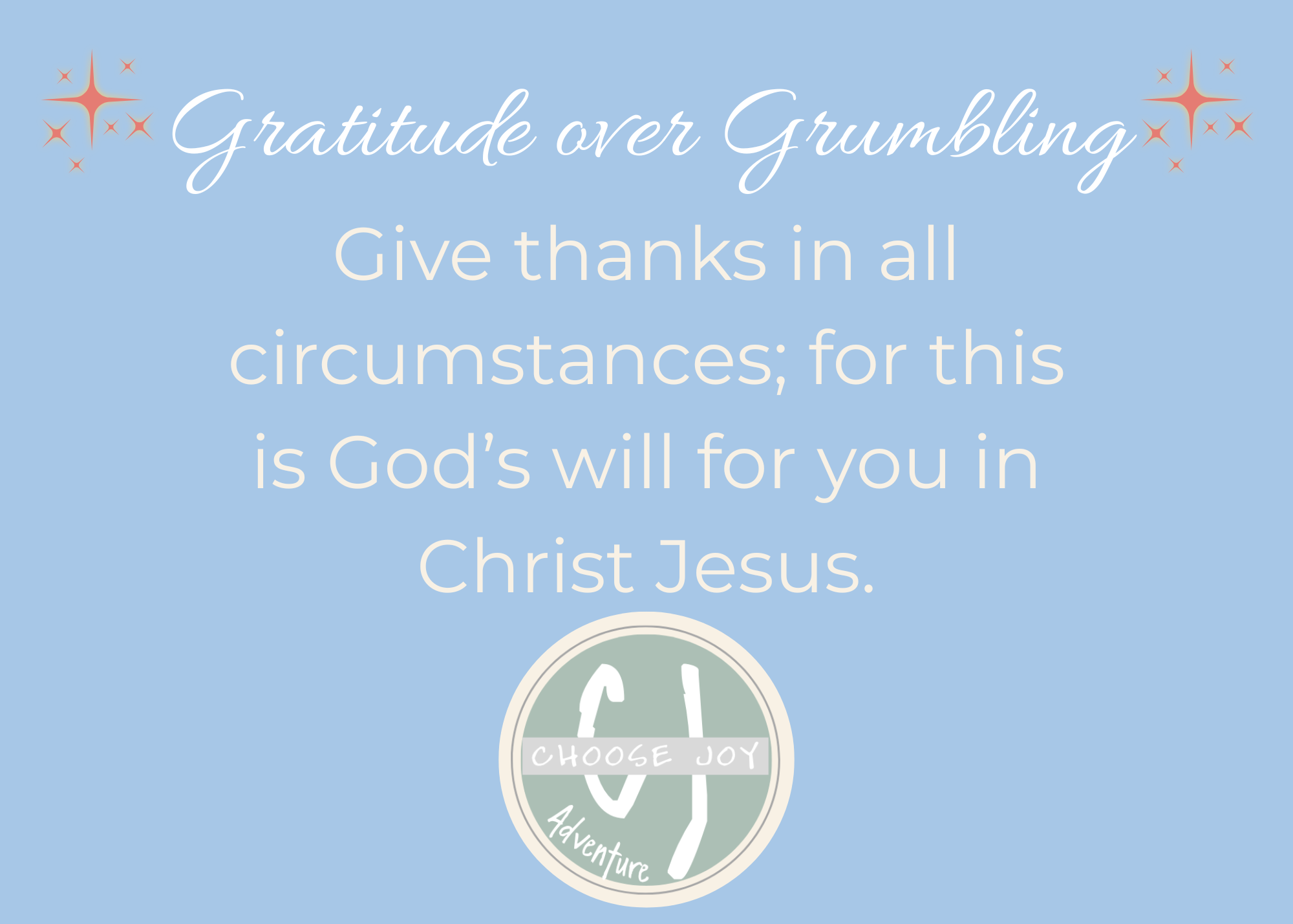
    Gratitude over Grumbling

    “Give thanks in all circumstances; for this is God’s will for you in Christ Jesus.” — 1 Thessalonians 5:18

    It’s easy to grumble. Life gives us plenty of things to complain about—unexpected bills, long lines, family frustrations, inconvenient interruptions, or seasons that simply feel heavy.

    Grumbling often slips out before we even notice. But Scripture offers a radically different way of living: gratitude in all circumstances.

    Not for all circumstances—but in them.

    There’s a big difference.

    Grumbling focuses on what’s wrong, what’s missing, or what feels unfair. Gratitude, however, shifts our eyes upward. It anchors our hearts in the goodness of God, even when our surroundings are anything but good. It’s a spiritual posture—a choice to recognize God’s fingerprints in the middle of the mess.

    Gratitude Is Not a Feeling — It’s a Practice.

    Paul’s words in 1 Thessalonians 5:18 are not a gentle suggestion but a divine invitation. God knows that gratitude reshapes us:

    • It softens a hardening heart.
    • It calms an anxious mind.
    • It lifts our perspective from the earthly to the eternal.
    • It restores joy where discouragement once lived.

    When we practice gratitude, we open the door for God’s peace to steady us.

    Why do we grumble?

    Grumbling usually flows from:

    • Discontentment — We wish life looked different.
    • Comparison — Someone else seems to have more, better, easier.
    • Impatience — God’s timing doesn’t match our timeline.
    • Focus on the problem rather than on the Provider.

    But grumbling never changes our circumstances—it only changes us, and not for the better. It drains hope, dims faith, and disconnects us from joy.

    Gratitude on the other hand, shifts everything!

    When we choose gratitude:

    • Our eyes open to God’s activity.
    • Our hearts become more flexible and less frustrated.
    • Our tongues become instruments of praise instead of complaint.
    • Our spirits grow stronger in resilience and hope.

    Gratitude isn’t pretending everything is perfect. It’s declaring that God is faithful, even here.

    So, what does gratitude sounds like? It sounds like…

    “Lord, this situation is hard…
    but thank You that You are with me.”

    “God, I don’t understand…
    but thank You that You’re working behind the scenes.”

    “Heavenly Father, this is not what I expected…
    but thank You that Your plans are good.”

    Gratitude doesn’t deny reality—it invites God into it.

    Here are a few simple tips to help you Choose Gratitude Over Grumbling.

    1. Pause and Notice

    Every time you feel a complaint rising, stop and ask:
    Is this moment an opportunity to give thanks instead?

    2. Name One Good Thing

    Look for the blessing hidden in plain sight—big or small.

    3. Thank God Out Loud

    There’s power in spoken gratitude.
    It strengthens faith and silences negativity.

    4. Replace the Grumble

    Turn every complaint into a praise:
    “I’m tired… but thank You for strength.”
    “This is stressful… but thank You for guiding me.”

    5. Make Gratitude a Daily Habit

    A gratitude list, prayer journal, or end-of-day reflection can transform your heart over time.

    When we choose gratitude, we reflect Christ.
    We shine differently.
    We walk differently.
    We live in God’s will.

    Gratitude doesn’t change what we face—but it changes how we face it.

    Today, may you choose gratitude over grumbling.

    May you discover God’s goodness in the ordinary, the difficult, and the unexpected.

    And may your heart overflow with thanksgiving, just as Scripture encourages.

    With love and joy,

    Laura
    Fediverse reactions
  • Let Go of Control: Resting in God’s Perfect Peace

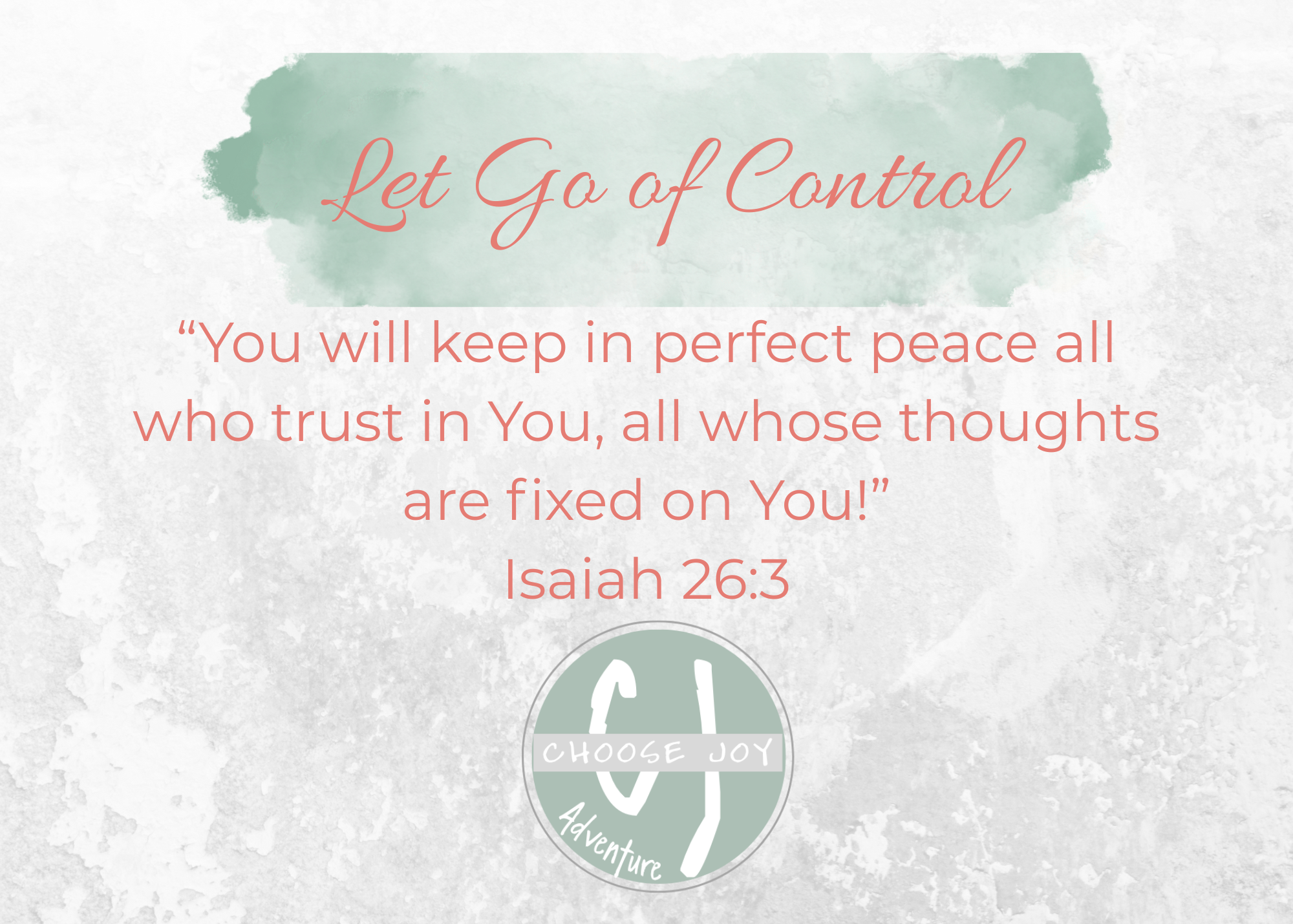
    Let Go of Control: Resting in God’s Perfect Peace

    “You will keep in perfect peace all who trust in You, all whose thoughts are fixed on You!”
    Isaiah 26:3

    There’s a moment in every journey where we realize that our hands are wrapped tightly around something we cannot actually steer. We grip harder, convinced that if we just try a little more, worry a little more, think a little more… we’ll finally feel peace. But the truth is, the tighter we hold, the more anxious we become.

    Isaiah 26:3 invites us into a different way:
    Perfect peace is not found in control—it’s found in trust.

    “Perfect peace” isn’t the absence of storms, the quieting of chaotic circumstances, or the guarantee that everything will go according to our plan. It is a steady calm that flows from knowing the One who holds all things.

    God’s peace is not fragile.
    It is not dependent on outcomes.
    It is rooted in His unchanging character.

    When Isaiah wrote these words, the people weren’t experiencing carefree days. They were facing uncertainty, enemies, and questions about the future. And yet, God promised peace to those who trust Him—deeply, fully, continually.

    Trying to control everything is exhausting.
    We want to predict outcomes, avoid pain, secure guarantees, and prevent surprises. But the more we attempt to gather every detail in our hands, the more we feel the pressure of holding it all together.

    Control is a weight we were never meant to carry.

    It brings worry, fear, and sleepless nights. It whispers, “If you don’t fix this, everything will fall apart.” But God gently invites us to loosen our grip. To stop trying to be our own savior. To rest.

    Isaiah says peace comes when our thoughts are “fixed on Him.”

    That word “fixed” means intentionally anchored. It’s choosing to turn our mind from the what-ifs and place it on the what-is true about God:

    • He is faithful.
    • He is sovereign.
    • He is good.
    • He is present.
    • He is loving.

    When we fix our thoughts on these truths, we shift from anxiety to assurance—because our focus moves from the storm to the Savior.

    Letting go doesn’t mean you stop caring or stop planning.
    Letting go means you trust that God’s hands are steadier than yours.

    It’s saying,
    “Lord, I release this to You. Lead me. Strengthen me. Keep me in Your peace.”

    It’s surrendering not out of defeat, but out of wisdom—because His plan is better, His perspective higher, and His peace deeper.

    Here is A Simple Practice to Lean Into Peace

    Try this today:

    1. Name the thing you’re trying to control.
      A relationship, a decision, a fear, a future.
    2. Invite God into it.
      Out loud if you can. “Lord, I trust You with this.”
    3. Shift your thoughts.
      Every time worry arises, repeat a truth about God’s character.

    Little by little, peace becomes the rhythm of your heart.

    Here is a simple prayer for you…

    Lord, I come to You with open hands and a heart that longs for Your peace. I confess that I’ve tried to carry things I was never meant to hold. Today, I release my need to control and choose to trust You. Fix my thoughts on Your goodness, and keep me in Your perfect peace. Amen.

    Perfect peace isn’t found when everything goes right—it’s found when we release everything into the hands of the One who is always right. Let go. Trust Him. And step into the peace He lovingly offers.

    Love and joy,

    Laura

    Fediverse reactions
  • Identity in Christ — You Are God’s Masterpiece

    Identity in Christ — You Are God’s Masterpiece

    “For we are God’s masterpiece. He has created us anew in Christ Jesus, so we can do the good things He planned for us long ago.”Ephesians 2:10 (NLT)

    Have you ever asked, “Who am I, really?

    Most of us spend years trying to answer that question through what we do, what others think, or what we’ve been through. But as Jamie Winship teaches, the truest thing about you is what God says about you.

    You are not your job, your past, your successes, or your struggles. You are God’s masterpiece. He designed you on purpose, for purpose — not to prove your worth, but to live from the worth He’s already given you in Christ.

    Living From Identity, Not For Identity

    I have been listening and reading from Jamie Winship and he often says that most of us live for identity — constantly striving to be seen as successful, good enough, loved, or valuable. But in Christ, we are invited to live from identity — a place of rest, freedom, and peace that comes from knowing who we already are.

    When you live for identity, life feels like performance. When you live from identity, life becomes partnership — walking with the One who created you to do “the good things He planned for you long ago.”

    Your identity in Christ is not earned; it’s received. It’s not a goal to achieve; it’s a gift to embrace.

    Hearing God’s Voice About Who You Are

    Jamie Winship encourages believers to ask God directly:

    “Lord, who do You say I am?”

    It’s a simple, yet life-changing prayer. God loves to reveal how He sees you — unique, loved, courageous, creative, joyful, chosen. These aren’t just nice affirmations; they’re spiritual realities.

    When you begin to agree with God’s truth over your life, fear and striving lose their grip. You start walking in the confidence of your original design — the “new creation” identity that Christ restored in you.

    The Freedom of Living in Truth

    Living in your true identity brings freedom. Jamie Winship calls it “living in truth and peace.” You no longer have to wear masks or try to be someone else. The pressure lifts. You can stop pretending and start participating — in the good works God designed just for you.

    When we align with who God says we are, we stop living in reaction to fear and start living in response to love. That’s where real transformation happens — not by striving harder, but by abiding deeper.

    • Have you been living for identity (to earn approval) or from identity (resting in who God says you are)?
    • Take time to sit quietly with God and ask, “Lord, who do You say I am?”
    • Write down what you sense He reveals — a word, image, or phrase — and walk in that truth this week.

    Father, I thank you that you have made us Your masterpiece. Created with purpose and love beyond measure. Teach us to live from our true identity in You, not for it. Silence the false names and lies we’ve believed and replace them with Your truth. Help us walk in the freedom, peace, and purpose you’ve designed for us.

    With love and joy,

    Laura

    Fediverse reactions
  • From Worry to Worship

    From Worry to Worship

    Philippians 4:6–7 — “Don’t worry about anything; instead, pray about everything. Tell God what you need, and thank Him for all He has done. Then you will experience God’s peace…”

    Worry is often our first reaction when life feels uncertain. It creeps in quietly and quickly—through unanswered prayers, unexpected detours, or the weight of responsibilities that feel too heavy to carry. Yet in Philippians 4:6–7, Paul offers a different response.

    Worry drains our energy and clouds our vision, but worship redirects both. When we worship, our focus shifts from the size of our problem to the greatness of our God. Prayer becomes our release valve—where anxiety is exchanged for assurance.

    Gratitude becomes our weapon—reminding us of God’s past faithfulness and His unchanging nature.

    It’s not that our circumstances instantly change when we pray; it’s that we do. The peace of God doesn’t depend on the absence of trouble but on the presence of the One who calms the storm inside of us. His peace “guards our hearts and minds,” standing like a divine shield against fear, doubt, and despair.

    So, when worry starts whispering, let worship rise louder.
    When anxiety starts to spiral, lift it up in prayer.
    When your thoughts feel tangled, anchor them in gratitude.

    Because every time you turn your worry into worship, you remind your heart who’s really in control. And in that surrender, peace begins to flow—steady, quiet, and strong.

    Reflect:

    • What situation are you most worried about right now?
    • How can you turn that concern into a prayer of worship and thanksgiving today?

    Prayer:
    Father, thank You for inviting me to trade my worries for Your peace. When I’m tempted to fear, remind me to bring every burden to You in prayer. Help me choose worship over worry, and gratitude over anxiety. Let Your peace guard my heart and mind in Christ Jesus. Amen.

    With love and joy,

    Laura

    Fediverse reactions
  • Guard your Inputs

    Guard your Inputs

    Guarding Your Inputs: Fixing Your Thoughts on What Is True

    “Fix your thoughts on what is true, and honorable, and right, and pure, and lovely, and admirable.” Philippians 4:8 

    We live in a world overflowing with noise, opinions, and endless content. What we allow into our hearts and minds matters more than ever.

    The truth is—our thoughts shape our attitudes, our words, and ultimately, our lives.

    Paul’s words in Philippians 4:8 remind us that we actively manage the information we receive. We are gatekeepers of our minds. What we dwell on, we begin to believe. What we believe, we begin to live out.

    When we constantly feed on negativity, fear, or comparison, our faith weakens and our joy fades. But when we fill our minds with what is true, honorable, and pure, we strengthen our spiritual focus. The promises of God, stories of grace, and reminders of His faithfulness contribute to our peace.

    There’s a saying that captures this truth well: “Where your focus goes, your energy flows.” Whatever you fix your thoughts on will grow stronger in your life. If your focus is on what’s wrong, your spirit will feel heavy. But if your focus is on God’s truth, peace, and promises, your faith will flourish. Guarding your inputs isn’t about ignoring reality. It involves choosing to give your attention to what leads to growth. It also encourages hope and holiness.

    Guarding your inputs means being intentional.

    It might look like reducing your time scrolling through social media. Be selective with the shows or music you consume. Choose conversations that lift your spirit instead of drain it.

    It’s not about isolation—it’s about wisdom.

    What you feed your mind determines the fruit your life will bear.

    Reflect & Act:

    1. Evaluate your inputs. What are you consistently listening to, watching, or reading?
    2. Replace the noise with truth. Start your day with Scripture instead of headlines.
    3. Surround yourself with godly voices. Community matters—walk with people who point you toward Christ.
    4. Renew your mind daily. Invite the Holy Spirit to guide what you consume and how you think.
    5. Refocus when distracted. When your mind drifts toward worry or negativity, gently redirect it toward God’s promises.

    I pray that God will help you fix your thoughts on what is true and pure. That He will teach you to guard your heart and mind from distractions that pull you away from Him. That He will fill you with His truth and help you live from a place of peace and clarity.

    With love and joy,

    Laura

    Fediverse reactions